自定义代理模板工作流程
自定义代理(Custom agents)以及基于代理的工作流程(Agent-based workflows)允许您通过直接继承相关类或接口,来定义任意复杂的协调逻辑(Orchestration logic)。 BaseAgent 并实现你自己的控制流(即你自己定义的程序执行逻辑)。这种方法使你能够创建新的执行模式,这些模式类似于……(原句中“similar to”后面的内容被省略了)。 SequentialAgent, LoopAgent,以及 ParallelAgent这使您能够构建高度定制化且复杂的代理工作流程(agent workflows)。
替代方案:基于图形的工作流程(graph-based workflows)
从 ADK 2.0 开始,支持使用基于代理(agent-based)的工作流程。
BaseAgent 已被取代。
通过更灵活的工作流程结构来实现(包括……) 基于图的工作流程(graph-based workflows) 和 动态工作流程(Dynamic Workflows)你应该评估这些工作流机制的功能和性能。 在……之前 为您的目标工作流程构建一个自定义代理(custom agent)。
高级概念
通过直接实现相关功能来构建自定义代理(custom agents)。 _run_async_impl该语言中的相关功能(或其在其他语言中的等效实现)提供了强大的控制能力,但使用起来比直接使用预定义的功能更为复杂。 LlmAgent 或者 WorkflowAgent 在研究自定义编排逻辑之前,我们建议先了解那些基础类型的代理(agents)。
概述
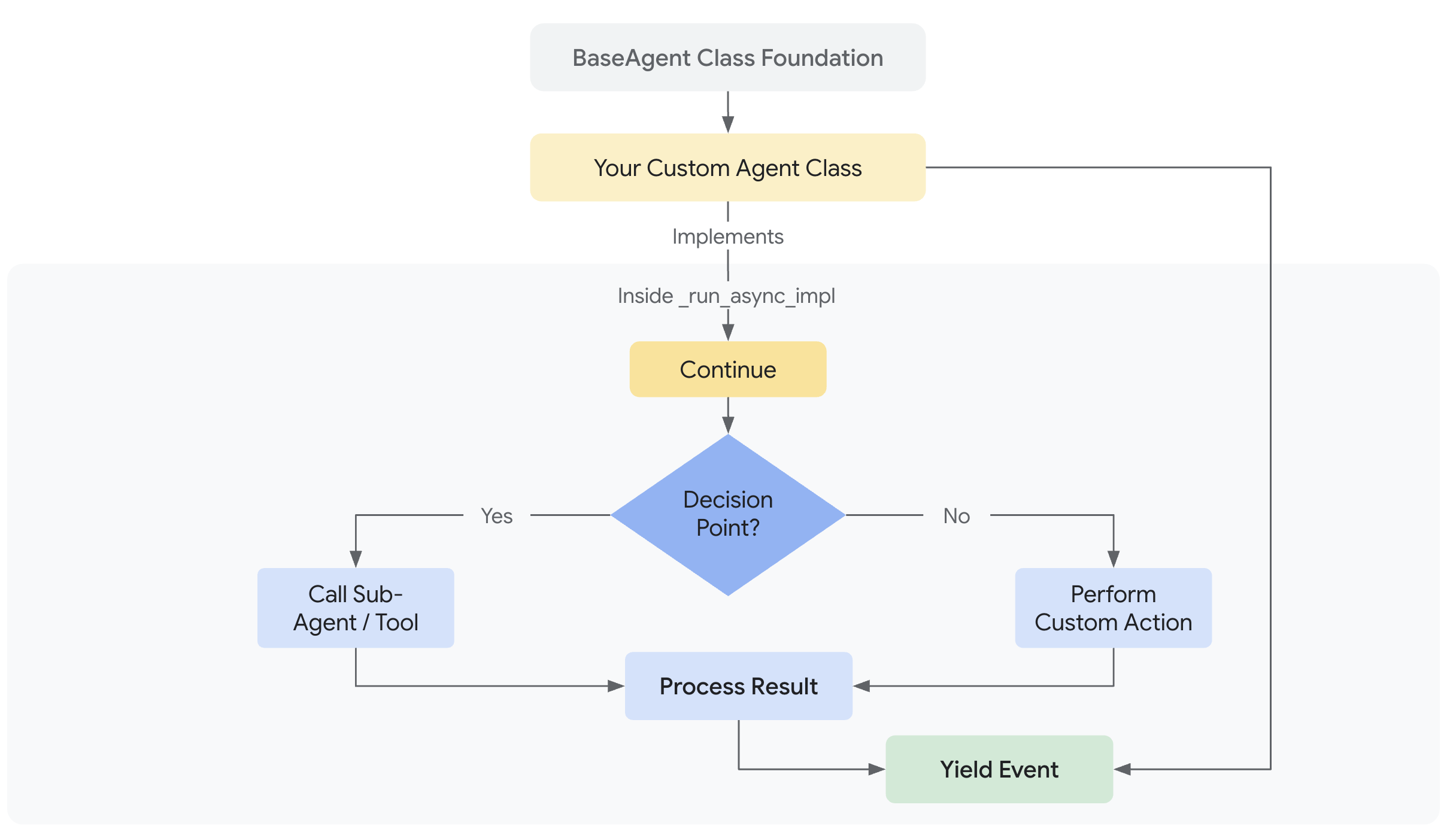
自定义代理(Custom Agent)本质上是指任何你创建的、继承自某个基类的类。
google.adk.agents.BaseAgent 并在其中实现了其核心执行逻辑。
_run_async_impl 这是一个异步方法(asynchronous method)。你可以完全控制该方法如何调用其他子代理(sub-agents)、如何管理状态(state),以及如何处理事件(events)。
注意:
用于实现代理核心异步逻辑的具体方法名称可能会因 SDK 语言的不同而略有差异。例如: runAsyncImpl 在 Java 中, _run_async_impl
在 Python 中,或者 runAsyncImpl 在 TypeScript 中,请参考与该语言相关的 API 文档以获取详细信息。
为什么要开发自定义代理(Custom Agents)呢?
在审查了现有的 ADK 之后…… 代理工作流程(Agent Workflow) 方法与架构: 如果现有的机制无法满足您项目的一个或多个要求,您可能需要考虑构建一个自定义的工作流代理(workflow agent)。
- 条件逻辑: 根据运行时的条件或前一步骤的结果,执行不同的子任务(sub-agents),或选择不同的处理路径。
- 复杂状态管理: 需要实现复杂的逻辑,以便在整个工作流程中维护和更新状态(而不仅仅是简单地按顺序传递数据)。
- 外部集成: 将对外部 API、数据库或自定义库的调用直接集成到编排流程的控制逻辑中。
- 动态代理选择(Dynamic Agent Selection): 根据对当前情况或输入数据的动态评估,来决定接下来应该运行哪个(哪些)子代理。
- 独特的工作流程模式: 实现不符合标准顺序、并行或循环结构的编排逻辑。
实现自定义逻辑
任何自定义代理的核心都在于那个用于定义其独特异步行为的方法。该方法使你能够协调各个子代理的运行,并管理整个执行流程。
任何自定义代理的核心都是…… _run_async_impl `method`:在这里,你需要定义该方法的独特行为(即该方法的具体实现逻辑)。
- 签名:
async def _run_async_impl(self, ctx: InvocationContext) -> AsyncGenerator[Event, None]: - 异步发电机: 这一定是一个……
async def这个函数用于执行某些操作,并返回结果。AsyncGenerator这使它能够……yield由子代理或其自身逻辑生成的事件会被发送回“runner”(即负责处理这些事件的主程序)。 ctx(InvocationContext): 提供了对关键运行时信息的访问权限;其中最重要的是……ctx.session.state这是通过您的自定义代理协调各个步骤之间共享数据的主要方式。- 实时音频和视频流: The
_run_async_impl该方法仅适用于非实时(非在线)的运行环境。run_async()为了提供支持……run_live()同时,也可以进行覆盖(即修改原有的代码或设置)。_run_live_impl该代码具有相同的签名(signature)。如果没有进行相应的覆盖(override)操作,那么在实时运行(live runs)过程中就会出现问题。NotImplementedError.
任何自定义代理的核心都是…… runAsyncImpl `method`:在这里,你需要定义该方法的独特行为(即该方法的具体实现逻辑)。
- 签名:
async* runAsyncImpl(ctx: InvocationContext): AsyncGenerator<Event, void, undefined> - 异步发电机: 这一定是一个……
async生成器函数(generator function)async*). ctx(InvocationContext): 提供了对关键运行时信息的访问权限;其中最重要的是……ctx.session.state这是通过您的自定义代理协调各个步骤之间共享数据的主要方式。
在 Go 语言中,你可以通过传递相关参数来创建一个自定义代理(custom agent)。 Run 函数 to agent.New 在……情况下;在……环境中 agent.Config你无法实现这个功能。 agent.Agent 由于该接口包含一个未导出的方法,因此无法直接使用该接口。实际的逻辑通常位于你的自定义代理结构体(custom agent struct)中的某个方法中,你需要将该结构体作为参数传递给其他组件或函数。 Run.
- 签名:
Run(ctx agent.InvocationContext) iter.Seq2[*session.Event, error] - Iterator: The
Run该方法返回一个迭代器(iterator)。iter.Seq2该方法会生成相应的事件(events)和错误(errors)。这是处理代理执行过程中产生的流式数据(streaming results)的标准方式。 ctx(InvocationContext): Theagent.InvocationContext它提供了对会话(包括会话状态)以及其他关键运行时信息的访问权限。- 会话状态(Session State): 您可以通过以下方式访问会话状态:
ctx.Session().State().
任何自定义代理的核心都是…… runAsyncImpl 该方法是从某个基类中继承而来的,你需要对其进行重写(override)。 BaseAgent.
- 签名:
protected Flowable<Event> runAsyncImpl(InvocationContext ctx) - Reactive Stream(反应式流)
Flowable): 它必须返回一个值。io.reactivex.rxjava3.core.Flowable<Event>. 这Flowable表示一系列事件,这些事件将由自定义代理的逻辑生成(通常是通过组合或转换多个数据源来生成的)。Flowablefrom sub-agents. ctx(InvocationContext): 提供了对关键运行时信息的访问权限;其中最重要的是……ctx.session().state()这是一个……(具体内容在文档中未提供)。java.util.concurrent.ConcurrentMap<String, Object>这是通过您的自定义代理来协调各个步骤之间共享数据的主要方式。
核心异步方法中的关键功能
-
正在联系下属代理人: 您会调用子代理(这些子代理通常作为实例属性存储,例如……)
self.my_llm_agent)使用他们的run_async这些方法会生成相应的事件(events),并通过 `yield` 语句将这些事件传递出去。 -
管理状态(Managing State): 从会话状态字典中读取数据,并向其中写入数据。)
ctx.session.state用于在子代理之间的调用之间传递数据或做出决策:# Read data set by a previous agent previous_result = ctx.session.state.get("some_key") # Make a decision based on state if previous_result == "some_value": # ... call a specific sub-agent ... else: # ... call another sub-agent ... # Store a result for a later step (often done via a sub-agent's output_key) # ctx.session.state["my_custom_result"] = "calculated_value" -
实现控制流: 使用标准的 Python 构造。
if/elif/else,for/while循环(loops)try/except)来创建复杂的工作流程,这些流程可以包含条件判断或迭代操作,并且可以涉及您的下属代理(sub-agents)。
-
正在联系下属代理人: 你需要调用子代理(这些子代理通常作为实例属性存储在系统中)。
this.myLlmAgent)使用他们的run这些方法会生成相应的事件(events),并通过 `yield` 语句将这些事件传递出去。 -
管理状态(Managing State): 从会话状态对象中读取数据,并向其中写入数据。)
ctx.session.state用于在子代理之间的调用之间传递数据或做出决策:// Read data set by a previous agent const previousResult = ctx.session.state['some_key']; // Make a decision based on state if (previousResult === 'some_value') { // ... call a specific sub-agent ... } else { // ... call another sub-agent ... } // Store a result for a later step (often done via a sub-agent's outputKey) // ctx.session.state['my_custom_result'] = 'calculated_value'; -
实现控制流: 使用标准的 TypeScript/JavaScript 构造。
if/else,for/while循环(loops)try/catch)来创建复杂的工作流程,这些流程可以包含条件判断或迭代操作,并且可以涉及您的下属代理(sub-agents)。
-
正在联系下属代理人: 你通过调用子代理的相应函数来启动它们。
Runmethod. -
管理状态(Managing State): 从会话状态中读取数据并写入会话状态,以便在子代理之间的调用之间传递数据或做出决策。
// The `ctx` (`agent.InvocationContext`) is passed directly to your agent's `Run` function. // Read data set by a previous agent previousResult, err := ctx.Session().State().Get("some_key") if err != nil { // Handle cases where the key might not exist yet } // Make a decision based on state if val, ok := previousResult.(string); ok && val == "some_value" { // ... call a specific sub-agent ... } else { // ... call another sub-agent ... } // Store a result for a later step if err := ctx.Session().State().Set("my_custom_result", "calculated_value"); err != nil { // Handle error } -
实现控制流: 使用标准的 Go 语言结构。)
if/else,for/switch(循环、goroutine、通道等)来创建复杂的工作流程,这些流程可以包含条件判断或迭代操作,并且能够与你的子代理(sub-agents)进行交互。
-
正在联系下属代理人: 你通过调用子代理(这些子代理通常被存储为实例属性或对象)的异步运行方法来启动它们,并获取它们产生的事件流(event streams)作为返回结果。
通常情况下,你会将这些元素链接(或组合)在一起使用。
Flowable从子代理那里获取数据(使用 RxJava 操作符进行数据处理)……concatWith,flatMapPublisher,或concatArray.The// Example: Running one sub-agent // return someSubAgent.runAsync(ctx); // Example: Running sub-agents sequentially Flowable<Event> firstAgentEvents = someSubAgent1.runAsync(ctx) .doOnNext(event -> System.out.println("Event from agent 1: " + event.id())); Flowable<Event> secondAgentEvents = Flowable.defer(() -> someSubAgent2.runAsync(ctx) .doOnNext(event -> System.out.println("Event from agent 2: " + event.id())) ); return firstAgentEvents.concatWith(secondAgentEvents);Flowable.defer()如果后续阶段的执行依赖于前几个阶段的完成情况或状态,那么这些后续阶段通常会被纳入流程中。 -
管理状态(Managing State): 从会话状态中读取数据并写入其中,以便在子代理之间的调用之间传递数据或做出决策。会话状态是一个……(此处原文内容不完整)。
java.util.concurrent.ConcurrentMap<String, Object>通过……获得ctx.session().state().// Read data set by a previous agent Object previousResult = ctx.session().state().get("some_key"); // Make a decision based on state if ("some_value".equals(previousResult)) { // ... logic to include a specific sub-agent's Flowable ... } else { // ... logic to include another sub-agent's Flowable ... } // Store a result for a later step (often done via a sub-agent's output_key) // ctx.session().state().put("my_custom_result", "calculated_value"); -
实现控制流: 使用标准的语言结构。)
if/else循环(loops)try/catch这些功能可以与反应式操作符(RxJava)结合使用,从而构建出复杂的工作流程。- 条件性(Conditional):
Flowable.defer()用于选择其中哪一个Flowable根据某个条件来订阅(某个服务或内容);filter()如果你正在流(stream)中过滤事件的话…… - 迭代(Iterative): 像这样的运算符:
repeat(),retry()或者,通过合理地组织你的数据结构(structuring your data)来实现这一点。Flowable这种链式结构可以根据特定条件递归地调用自身的各个部分(这些条件通常由相应的逻辑或管理机制来控制)。flatMapPublisher或者concatMap).
- 条件性(Conditional):
管理子代理及其状态
通常,一个自定义代理会协调其他代理(例如……)的执行。 LlmAgent, LoopAgent(等等)。
- 初始化: 通常,你会将这些子代理的实例传递给自定义代理的构造函数,并将它们存储为实例字段或属性(例如:
this.story_generator = story_generator_instance或者self.story_generator = story_generator_instance这使得这些功能可以在自定义代理的核心异步执行逻辑中被使用(例如:_run_async_impl(方法)。在 Python 中,BaseAgent这是一个使用 Pydantic 框架配置的模型。extra='forbid'因此,你需要将每个子代理(sub-agent)声明为一个带有注释的类级字段(class-level field),例如:story_generator: LlmAgent将其传递给……super().__init__(...)为某个对象分配一个未声明的属性……__init__引发(某种问题或情况);引起(人们的注意或反应)ValueError. - 子代理列表: 在初始化时……
BaseAgent使用它的(“using it’s”中的“it’s”是“it is”的缩写)super()在构造函数中,你应该传递一个参数。sub agents这个列表用于向 ADK 框架说明哪些代理属于该自定义代理的直接层级结构中。对于诸如生命周期管理、代理状态查询(introspection)以及未来的路由功能等框架特性来说,这个列表非常重要——即使你的核心执行逻辑(core execution logic)本身并不依赖于这些信息。_run_async_impl)通过该方式直接联系代理人员。self.xxx_agent将您的自定义逻辑直接调用的代理(agents)包含在顶层(top level)中。 - 状态: 正如前面提到的,
ctx.session.state这是次级代理(尤其是……)的标准操作方式。LlmAgent使用(s using)output key)如何将结果反馈给协调器(orchestrator),以及协调器如何向下传递必要的输入数据。
基于代理的工作流原语(Agent-based workflow primitives)
以下章节详细介绍了 ADK 的核心原语(如代理层次结构、工作流代理以及交互机制),这些原语能够帮助您有效地构建和管理多代理系统。ADK 提供了用于构建多代理系统的基本组件(即这些核心原语),使您能够对这些系统中的交互行为进行结构化设计与管理。
注意:
这些基本类型(primitives)的具体参数或方法名称可能会因 SDK 使用的语言而略有不同。例如: sub_agents 在 Python 中,以及…… subAgents 在 Java 中,请参考与该语言相关的 API 文档以获取详细信息。
代理层级结构:上级代理(Parent agents)与下级代理(Sub-agents)
构建多智能体系统的基础,是其中定义的“父子关系”(即父智能体与子智能体之间的层级结构)。 BaseAgent.
- 建立层次结构: 你可以通过将一组代理实例(agent instances)传递给某个函数或方法来创建一个树状结构。
sub_agents在初始化父代理时需要传递一个参数。ADK 会自动设置该参数的值。parent_agent在初始化过程中,为每个子代理分配相应的属性。 - 单亲家长规则: 一个代理实例只能被添加为次级代理(即子代理)一次。如果尝试为其分配第二个上级代理,将会导致错误或问题。
ValueError. - 重要性: 这个层次结构定义了……的范围(即该结构所涵盖的范围或适用的范围)。 工作流代理(Workflow Agents) 这些因素会影响由大型语言模型(LLM)驱动的“任务委托”(Delegation)机制的潜在目标对象。你可以使用相应的工具来浏览这个层次结构(hierarchy)。
agent.parent_agent或者使用相关方法来查找这些对象的“后代”(即这些对象的子对象或后代对象)。agent.find_agent(name).
# Conceptual Example: Defining Hierarchy
from typing import AsyncGenerator

from google.adk.agents import LlmAgent, BaseAgent
from google.adk.agents.invocation_context import InvocationContext
from google.adk.events import Event


# A custom non-LLM agent must implement _run_async_impl; instantiating
# BaseAgent directly raises NotImplementedError when it runs.
class TaskExecutor(BaseAgent):
    async def _run_async_impl(
        self, ctx: InvocationContext
    ) -> AsyncGenerator[Event, None]:
        yield Event(author=self.name)


# Define individual agents
greeter = LlmAgent(name="Greeter", model="gemini-flash-latest")
task_doer = TaskExecutor(name="TaskExecutor") # Custom non-LLM agent


# Create parent agent and assign children via sub_agents
coordinator = LlmAgent(
    name="Coordinator",
    model="gemini-flash-latest",
    description="I coordinate greetings and tasks.",
    sub_agents=[ # Assign sub_agents here
        greeter,
        task_doer
    ]
)


# Framework automatically sets:
# assert greeter.parent_agent == coordinator
# assert task_doer.parent_agent == coordinator
// Conceptual Example: Defining Hierarchy
import { LlmAgent, BaseAgent, InvocationContext } from '@google/adk';
import type { Event, createEventActions } from '@google/adk';

class TaskExecutorAgent extends BaseAgent {
  async *runAsyncImpl(context: InvocationContext): AsyncGenerator<Event, void, void> {
    yield {
      id: 'event-1',
      invocationId: context.invocationId,
      author: this.name,
      content: { parts: [{ text: 'Task completed!' }] },
      actions: createEventActions(),
      timestamp: Date.now(),
    };
  }
  async *runLiveImpl(context: InvocationContext): AsyncGenerator<Event, void, void> {
    this.runAsyncImpl(context);
  }
}

// Define individual agents
const greeter = new LlmAgent({name: 'Greeter', model: 'gemini-flash-latest'});
const taskDoer = new TaskExecutorAgent({name: 'TaskExecutor'}); // Custom non-LLM agent

// Create parent agent and assign children via subAgents
const coordinator = new LlmAgent({
    name: 'Coordinator',
    model: 'gemini-flash-latest',
    description: 'I coordinate greetings and tasks.',
    subAgents: [ // Assign subAgents here
        greeter,
        taskDoer
    ],
});

// Framework automatically sets:
// console.assert(greeter.parentAgent === coordinator);
// console.assert(taskDoer.parentAgent === coordinator);
import (
    "google.golang.org/adk/v2/agent"
    "google.golang.org/adk/v2/agent/llmagent"
)

// Conceptual Example: Defining Hierarchy
// Define individual agents
greeter, _ := llmagent.New(llmagent.Config{Name: "Greeter", Model: m})
taskDoer, _ := agent.New(agent.Config{Name: "TaskExecutor"}) // Custom non-LLM agent

// Create parent agent and assign children via sub_agents
coordinator, _ := llmagent.New(llmagent.Config{
    Name:        "Coordinator",
    Model:       m,
    Description: "I coordinate greetings and tasks.",
    SubAgents:   []agent.Agent{greeter, taskDoer}, // Assign sub_agents here
})
// Conceptual Example: Defining Hierarchy
import com.google.adk.agents.SequentialAgent;
import com.google.adk.agents.LlmAgent;


// Define individual agents
LlmAgent greeter = LlmAgent.builder().name("Greeter").model("gemini-flash-latest").build();
SequentialAgent taskDoer = SequentialAgent.builder().name("TaskExecutor").subAgents(...).build(); // Sequential Agent


// Create parent agent and assign sub_agents
LlmAgent coordinator = LlmAgent.builder()
    .name("Coordinator")
    .model("gemini-flash-latest")
    .description("I coordinate greetings and tasks")
    .subAgents(greeter, taskDoer) // Assign sub_agents here
    .build();


// Framework automatically sets:
// assert greeter.parentAgent().equals(coordinator);
// assert taskDoer.parentAgent().equals(coordinator);
class TaskExecutorAgent : BaseAgent(name = "TaskExecutor") {
    override fun runAsyncImpl(context: InvocationContext): Flow<Event> {
        return flowOf(
            Event(
                author = name,
                content = Content(parts = listOf(Part(text = "Task completed!"))),
            ),
        )
    }
}
val greeter = LlmAgent(name = "Greeter", model = model)
val taskDoer = TaskExecutorAgent()

val coordinator =
    LlmAgent(
        name = "Coordinator",
        model = model,
        description = "I coordinate greetings and tasks.",
        subAgents = listOf(greeter, taskDoer),
    )
工作流代理作为编排器(Workflow agents acting as orchestrators)
ADK 包含了一些专门设计的代理程序(agents),这些代理程序是从其他组件或技术中衍生而来的。 BaseAgent 这些组件本身并不执行具体任务,而是负责协调各个组件的执行流程。 sub_agents.
在 Python 和 TypeScript 中已被弃用。
在 Python 和 TypeScript 中, SequentialAgent, ParallelAgent,以及
LoopAgent 已被弃用,转而使用…… Workflow在构建这些类的过程中,会生成一条关于这些类已被弃用的警告(deprecation warning);这些类将在未来的版本中被移除。 Workflow 不能被用作…… LlmAgent 子代理(sub-agent)。
SequentialAgent: 执行其(命令或功能)sub_agents按照列出的顺序,一个接一个地出现。- 背景信息(Context): 通过了 same
InvocationContext这些操作是按顺序进行的,因此代理可以轻松地通过共享的状态来传递结果。
- 背景信息(Context): 通过了 same
# Conceptual Example: Sequential Pipeline
from google.adk.agents import SequentialAgent, LlmAgent

step1 = LlmAgent(name="Step1_Fetch", output_key="data") # Saves output to state['data']
step2 = LlmAgent(name="Step2_Process", instruction="Process data from {data}.")

pipeline = SequentialAgent(name="MyPipeline", sub_agents=[step1, step2])
# When pipeline runs, Step2 can access the state['data'] set by Step1.
// Conceptual Example: Sequential Pipeline
import { SequentialAgent, LlmAgent } from '@google/adk';

const step1 = new LlmAgent({name: 'Step1_Fetch', outputKey: 'data'}); // Saves output to state['data']
const step2 = new LlmAgent({name: 'Step2_Process', instruction: 'Process data from {data}.'});

const pipeline = new SequentialAgent({name: 'MyPipeline', subAgents: [step1, step2]});
// When pipeline runs, Step2 can access the state['data'] set by Step1.
import (
    "google.golang.org/adk/v2/agent"
    "google.golang.org/adk/v2/agent/llmagent"
    "google.golang.org/adk/v2/agent/workflowagents/sequentialagent"
)

// Conceptual Example: Sequential Pipeline
step1, _ := llmagent.New(llmagent.Config{Name: "Step1_Fetch", OutputKey: "data", Model: m}) // Saves output to state["data"]
step2, _ := llmagent.New(llmagent.Config{Name: "Step2_Process", Instruction: "Process data from {data}.", Model: m})

pipeline, _ := sequentialagent.New(sequentialagent.Config{
    AgentConfig: agent.Config{Name: "MyPipeline", SubAgents: []agent.Agent{step1, step2}},
})
// When pipeline runs, Step2 can access the state["data"] set by Step1.
// Conceptual Example: Sequential Pipeline
import com.google.adk.agents.SequentialAgent;
import com.google.adk.agents.LlmAgent;

LlmAgent step1 = LlmAgent.builder().name("Step1_Fetch").outputKey("data").build(); // Saves output to state.get("data")
LlmAgent step2 = LlmAgent.builder().name("Step2_Process").instruction("Process data from {data}.").build();

SequentialAgent pipeline = SequentialAgent.builder().name("MyPipeline").subAgents(step1, step2).build();
// When pipeline runs, Step2 can access the state.get("data") set by Step1.
ParallelAgent: 执行其(命令或功能)sub_agents这些事件可以同时发生(即并行执行);来自子代理的事件可能会被交错地显示或处理。- 背景信息(Context): 修改(或调整)……
InvocationContext.branch对于每个子代理(例如:)……ParentBranch.ChildName这提供了一种独特的上下文路径(contextual path),在某些内存实现中,该路径有助于隔离历史数据(即之前存储的数据)。 - 状态: 尽管这些分支各自独立,但所有并行执行的子进程(即“children”)仍然可以访问相同的资源或数据。 相同的共享资源(或数据)
session.state这使他们能够读取初始状态并写入结果(使用不同的键来避免竞争条件)。
- 背景信息(Context): 修改(或调整)……
# Conceptual Example: Parallel Execution
from google.adk.agents import ParallelAgent, LlmAgent

fetch_weather = LlmAgent(name="WeatherFetcher", output_key="weather")
fetch_news = LlmAgent(name="NewsFetcher", output_key="news")

gatherer = ParallelAgent(name="InfoGatherer", sub_agents=[fetch_weather, fetch_news])
# When gatherer runs, WeatherFetcher and NewsFetcher run concurrently.
# A subsequent agent could read state['weather'] and state['news'].
// Conceptual Example: Parallel Execution
import { ParallelAgent, LlmAgent } from '@google/adk';

const fetchWeather = new LlmAgent({name: 'WeatherFetcher', outputKey: 'weather'});
const fetchNews = new LlmAgent({name: 'NewsFetcher', outputKey: 'news'});

const gatherer = new ParallelAgent({name: 'InfoGatherer', subAgents: [fetchWeather, fetchNews]});
// When gatherer runs, WeatherFetcher and NewsFetcher run concurrently.
// A subsequent agent could read state['weather'] and state['news'].
import (
    "google.golang.org/adk/v2/agent"
    "google.golang.org/adk/v2/agent/llmagent"
    "google.golang.org/adk/v2/agent/workflowagents/parallelagent"
)

// Conceptual Example: Parallel Execution
fetchWeather, _ := llmagent.New(llmagent.Config{Name: "WeatherFetcher", OutputKey: "weather", Model: m})
fetchNews, _ := llmagent.New(llmagent.Config{Name: "NewsFetcher", OutputKey: "news", Model: m})

gatherer, _ := parallelagent.New(parallelagent.Config{
    AgentConfig: agent.Config{Name: "InfoGatherer", SubAgents: []agent.Agent{fetchWeather, fetchNews}},
})
// When gatherer runs, WeatherFetcher and NewsFetcher run concurrently.
// A subsequent agent could read state["weather"] and state["news"].
// Conceptual Example: Parallel Execution
import com.google.adk.agents.LlmAgent;
import com.google.adk.agents.ParallelAgent;


LlmAgent fetchWeather = LlmAgent.builder()
    .name("WeatherFetcher")
    .outputKey("weather")
    .build();


LlmAgent fetchNews = LlmAgent.builder()
    .name("NewsFetcher")
    .instruction("news")
    .build();


ParallelAgent gatherer = ParallelAgent.builder()
    .name("InfoGatherer")
    .subAgents(fetchWeather, fetchNews)
    .build();


// When gatherer runs, WeatherFetcher and NewsFetcher run concurrently.
// A subsequent agent could read state['weather'] and state['news'].
LoopAgent: 执行其(命令或功能)sub_agents在循环中按顺序执行这些操作。- 终止: 如果提供了可选条件(optional condition),则循环会停止。
max_iterations是否已经达到某个条件;或者是否有任何子代理返回了某个结果(或信息)。Event使用(with)escalate=True在其事件处理(Event Actions)功能中。 - 上下文(Context)与状态(State): 通过了 same
InvocationContext在每次迭代过程中,都允许状态变化(例如计数器、标志位等)在循环之间保持持久性(即这些变化不会在循环结束后被清除)。
- 终止: 如果提供了可选条件(optional condition),则循环会停止。
# Conceptual Example: Loop with Condition
from google.adk.agents import LoopAgent, LlmAgent, BaseAgent
from google.adk.events import Event, EventActions
from google.adk.agents.invocation_context import InvocationContext
from typing import AsyncGenerator

class CheckCondition(BaseAgent): # Custom agent to check state
    async def _run_async_impl(self, ctx: InvocationContext) -> AsyncGenerator[Event, None]:
        status = ctx.session.state.get("status", "pending")
        is_done = (status == "completed")
        yield Event(author=self.name, actions=EventActions(escalate=is_done)) # Escalate if done

process_step = LlmAgent(name="ProcessingStep") # Agent that might update state['status']

poller = LoopAgent(
    name="StatusPoller",
    max_iterations=10,
    sub_agents=[process_step, CheckCondition(name="Checker")]
)
# When poller runs, it executes process_step then Checker repeatedly
# until Checker escalates (state['status'] == 'completed') or 10 iterations pass.
// Conceptual Example: Loop with Condition
import { LoopAgent, LlmAgent, BaseAgent, InvocationContext } from '@google/adk';
import type { Event, createEventActions, EventActions } from '@google/adk';

class CheckConditionAgent extends BaseAgent { // Custom agent to check state
    async *runAsyncImpl(ctx: InvocationContext): AsyncGenerator<Event> {
        const status = ctx.session.state['status'] || 'pending';
        const isDone = status === 'completed';
        yield createEvent({ author: 'check_condition', actions: createEventActions({ escalate: isDone }) });
    }

    async *runLiveImpl(ctx: InvocationContext): AsyncGenerator<Event> {
        // This is not implemented.
    }
};

const processStep = new LlmAgent({name: 'ProcessingStep'}); // Agent that might update state['status']

const poller = new LoopAgent({
    name: 'StatusPoller',
    maxIterations: 10,
    // Executes its sub_agents sequentially in a loop
    subAgents: [processStep, new CheckConditionAgent ({name: 'Checker'})]
});
// When poller runs, it executes processStep then Checker repeatedly
// until Checker escalates (state['status'] === 'completed') or 10 iterations pass.
import (
    "iter"
    "google.golang.org/adk/v2/agent"
    "google.golang.org/adk/v2/agent/llmagent"
    "google.golang.org/adk/v2/agent/workflowagents/loopagent"
    "google.golang.org/adk/v2/session"
)

// Conceptual Example: Loop with Condition
// Custom agent to check state
checkCondition, _ := agent.New(agent.Config{
    Name: "Checker",
    Run: func(ctx agent.InvocationContext) iter.Seq2[*session.Event, error] {
        return func(yield func(*session.Event, error) bool) {
            status, err := ctx.Session().State().Get("status")
            // If "status" is not in the state, default to "pending".
            // This is idiomatic Go for handling a potential error on lookup.
            if err != nil {
                status = "pending"
            }
            isDone := status == "completed"
            yield(&session.Event{Author: "Checker", Actions: session.EventActions{Escalate: isDone}}, nil)
        }
    },
})

processStep, _ := llmagent.New(llmagent.Config{Name: "ProcessingStep", Model: m}) // Agent that might update state["status"]

poller, _ := loopagent.New(loopagent.Config{
    MaxIterations: 10,
    AgentConfig:   agent.Config{Name: "StatusPoller", SubAgents: []agent.Agent{processStep, checkCondition}},
})
// When poller runs, it executes processStep then Checker repeatedly
// until Checker escalates (state["status"] == "completed") or 10 iterations pass.
// Conceptual Example: Loop with Condition
// Custom agent to check state and potentially escalate
public static class CheckConditionAgent extends BaseAgent {
  public CheckConditionAgent(String name, String description) {
    super(name, description, List.of(), null, null);
  }

  @Override
  protected Flowable<Event> runAsyncImpl(InvocationContext ctx) {
    String status = (String) ctx.session().state().getOrDefault("status", "pending");
    boolean isDone = "completed".equalsIgnoreCase(status);

    // Emit an event that signals to escalate (exit the loop) if the condition is met.
    // If not done, the escalate flag will be false or absent, and the loop continues.
    Event checkEvent = Event.builder()
            .author(name())
            .id(Event.generateEventId()) // Important to give events unique IDs
            .actions(EventActions.builder().escalate(isDone).build()) // Escalate if done
            .build();
    return Flowable.just(checkEvent);
  }
}

// Agent that might update state.put("status")
LlmAgent processingStepAgent = LlmAgent.builder().name("ProcessingStep").build();
// Custom agent instance for checking the condition
CheckConditionAgent conditionCheckerAgent = new CheckConditionAgent(
    "ConditionChecker",
    "Checks if the status is 'completed'."
);
LoopAgent poller = LoopAgent.builder().name("StatusPoller").maxIterations(10).subAgents(processingStepAgent, conditionCheckerAgent).build();
// When poller runs, it executes processingStepAgent then conditionCheckerAgent repeatedly
// until Checker escalates (state.get("status") == "completed") or 10 iterations pass.
class CheckConditionAgent(name: String) : BaseAgent(name = name) {
    override fun runAsyncImpl(context: InvocationContext): Flow<Event> {
        val status = context.session.state["status"] as? String ?: "pending"
        val isDone = status == "completed"
        return flowOf(
            Event(
                author = name,
                actions = EventActions(escalate = isDone),
            ),
        )
    }
}
val processStep = LlmAgent(name = "ProcessingStep", model = model)
val checker = CheckConditionAgent(name = "Checker")

val poller =
    LoopAgent(
        name = "StatusPoller",
        maxIterations = 10,
        subAgents = listOf(processStep, checker),
    )
交互与沟通机制
系统中的各个组件(即“代理”)通常需要相互交换数据或触发某些操作。ADK 通过以下方式实现了这一点:
共享会话状态(Shared session state)
对于在同一调用中运行的代理(因此它们共享相同的资源/环境)来说,最基本的方法就是…… Session 通过该对象…… InvocationContext)用于进行被动式的交流(即不主动发起对话,而是等待对方的信息或行动)。
- **机制:** 一个代理(或其工具/回调函数)会写入一个值。
context.state['data_key'] = processed_data),然后由另一个代理程序来读取该数据。data = context.state.get('data_key')在 Python 中,CallbackContext和ToolContext它们都是同一个具有“delta-aware”(即能够检测数据变化)功能的上下文类(context class);对该类的任何写入操作(write operation)都会……context.state被记录为……state_delta当代理程序发出该信号时(on the event the agent emits)。 - 便利性: The
output_key“property on” 是一个编程术语,通常用于描述对象或结构中的某个属性(property)与另一个对象或结构之间的关系。这种关系可以是继承(inheritance)、关联(association)或其他类型的关系。具体含义取决于所使用的编程语言和上下文。LlmAgent会自动将代理的最终响应文本(或结构化输出)保存到指定的状态键中。 - Nature: 异步、被动的通信方式。非常适合用于那些由特定系统或流程协调执行的操作(即“管道化处理”)。
SequentialAgent或者是在不同系统/组件之间传递数据。LoopAgentiterations. - 另请参阅: 状态管理(State Management)
调用上下文(Invocation Context)以及…… temp: 状态
当一个父代理(parent agent)调用一个子代理(sub-agent)时,它会将相同的参数或信息传递给子代理。 InvocationContext这意味着它们使用相同的临时文件(或资源)。temp:)状态(state),这种机制非常适合用于传递那些仅与当前回合相关的数据。
# Conceptual Example: Using output_key and reading state
from google.adk.agents import LlmAgent, SequentialAgent


agent_A = LlmAgent(name="AgentA", instruction="Find the capital of France.", output_key="capital_city")
agent_B = LlmAgent(name="AgentB", instruction="Tell me about the city stored in {capital_city}.")


pipeline = SequentialAgent(name="CityInfo", sub_agents=[agent_A, agent_B])
# AgentA runs, saves "Paris" to state['capital_city'].
# AgentB runs, its instruction processor reads state['capital_city'] to get "Paris".
// Conceptual Example: Using outputKey and reading state
import { LlmAgent, SequentialAgent } from '@google/adk';

const agentA = new LlmAgent({name: 'AgentA', instruction: 'Find the capital of France.', outputKey: 'capital_city'});
const agentB = new LlmAgent({name: 'AgentB', instruction: 'Tell me about the city stored in {capital_city}.'});

const pipeline = new SequentialAgent({name: 'CityInfo', subAgents: [agentA, agentB]});
// AgentA runs, saves "Paris" to state['capital_city'].
// AgentB runs, its instruction processor reads state['capital_city'] to get "Paris".
import (
    "google.golang.org/adk/v2/agent"
    "google.golang.org/adk/v2/agent/llmagent"
    "google.golang.org/adk/v2/agent/workflowagents/sequentialagent"
)

// Conceptual Example: Using output_key and reading state
agentA, _ := llmagent.New(llmagent.Config{Name: "AgentA", Instruction: "Find the capital of France.", OutputKey: "capital_city", Model: m})
agentB, _ := llmagent.New(llmagent.Config{Name: "AgentB", Instruction: "Tell me about the city stored in {capital_city}.", Model: m})

pipeline2, _ := sequentialagent.New(sequentialagent.Config{
    AgentConfig: agent.Config{Name: "CityInfo", SubAgents: []agent.Agent{agentA, agentB}},
})
// AgentA runs, saves "Paris" to state["capital_city"].
// AgentB runs, its instruction processor reads state["capital_city"] to get "Paris".
// Conceptual Example: Using outputKey and reading state
import com.google.adk.agents.LlmAgent;
import com.google.adk.agents.SequentialAgent;


LlmAgent agentA = LlmAgent.builder()
    .name("AgentA")
    .instruction("Find the capital of France.")
    .outputKey("capital_city")
    .build();


LlmAgent agentB = LlmAgent.builder()
    .name("AgentB")
    .instruction("Tell me about the city stored in {capital_city}.")
    .outputKey("capital_city")
    .build();


SequentialAgent pipeline = SequentialAgent.builder().name("CityInfo").subAgents(agentA, agentB).build();
// AgentA runs, saves "Paris" to state('capital_city').
// AgentB runs, its instruction processor reads state.get("capital_city") to get "Paris".
val agentA =
    LlmAgent(
        name = "AgentA",
        model = model,
        instruction = Instruction("Find the capital of France."),
    )
val agentB =
    LlmAgent(
        name = "AgentB",
        model = model,
        instruction = Instruction("Tell me about the city stored in state."),
    )

val cityPipeline = SequentialAgent(name = "CityInfo", subAgents = listOf(agentA, agentB))
大型语言模型(LLM)的代理委托机制与代理转移技术
利用……(Leverages an 表示“利用某种资源、技术或方法”) LlmAgent该系统能够动态地将任务分配给层级结构中的其他合适代理(即能够处理这些任务的代理)。
- **机制:** 该代理的 Large Language Model(LLM)会生成一个特定的函数调用。
transfer_to_agent(agent_name='target_agent_name'). - 处理方式: The
AutoFlow当存在子代理(sub-agents)或转账操作未被禁止时,系统会默认使用该机制来拦截该呼叫。该机制通过特定方式识别目标代理(target agent)。root_agent.find_agent()并对其进行更新。InvocationContext用于切换执行焦点。 - 需要: “调用”(The calling)
LlmAgent需要进一步明确(或详细说明)。instructions关于何时进行转移,以及潜在的目标代理需要哪些不同的信息(或条件),这些都需要被明确界定。description该工具用于帮助大型语言模型(LLM)做出明智的决策。转移范围(父代理、子代理、同级代理)可以在配置中进行设置。LlmAgent. - Nature: 基于大型语言模型(LLM)的解释能力,实现动态、灵活的路由机制。
# Conceptual Setup: LLM Transfer
from google.adk.agents import LlmAgent


booking_agent = LlmAgent(name="Booker", description="Handles flight and hotel bookings.")
info_agent = LlmAgent(name="Info", description="Provides general information and answers questions.")


coordinator = LlmAgent(
    name="Coordinator",
    model="gemini-flash-latest",
    instruction="You are an assistant. Delegate booking tasks to Booker and info requests to Info.",
    description="Main coordinator.",
    # AutoFlow is typically used implicitly here
    sub_agents=[booking_agent, info_agent]
)
# If coordinator receives "Book a flight", its LLM should generate:
# FunctionCall(name='transfer_to_agent', args={'agent_name': 'Booker'})
# ADK framework then routes execution to booking_agent.
// Conceptual Setup: LLM Transfer
import { LlmAgent } from '@google/adk';

const bookingAgent = new LlmAgent({name: 'Booker', description: 'Handles flight and hotel bookings.'});
const infoAgent = new LlmAgent({name: 'Info', description: 'Provides general information and answers questions.'});

const coordinator = new LlmAgent({
    name: 'Coordinator',
    model: 'gemini-flash-latest',
    instruction: 'You are an assistant. Delegate booking tasks to Booker and info requests to Info.',
    description: 'Main coordinator.',
    // AutoFlow is typically used implicitly here
    subAgents: [bookingAgent, infoAgent]
});
// If coordinator receives "Book a flight", its LLM should generate:
// {functionCall: {name: 'transfer_to_agent', args: {agent_name: 'Booker'}}}
// ADK framework then routes execution to bookingAgent.
import (
    "google.golang.org/adk/v2/agent/llmagent"
)

// Conceptual Setup: LLM Transfer
bookingAgent, _ := llmagent.New(llmagent.Config{Name: "Booker", Description: "Handles flight and hotel bookings.", Model: m})
infoAgent, _ := llmagent.New(llmagent.Config{Name: "Info", Description: "Provides general information and answers questions.", Model: m})

coordinator, _ = llmagent.New(llmagent.Config{
    Name:        "Coordinator",
    Model:       m,
    Instruction: "You are an assistant. Delegate booking tasks to Booker and info requests to Info.",
    Description: "Main coordinator.",
    SubAgents:   []agent.Agent{bookingAgent, infoAgent},
})

// If coordinator receives "Book a flight", its LLM should generate:
// FunctionCall{Name: "transfer_to_agent", Args: map[string]any{"agent_name": "Booker"}}
// ADK framework then routes execution to bookingAgent.
// Conceptual Setup: LLM Transfer
import com.google.adk.agents.LlmAgent;


LlmAgent bookingAgent = LlmAgent.builder()
    .name("Booker")
    .description("Handles flight and hotel bookings.")
    .build();


LlmAgent infoAgent = LlmAgent.builder()
    .name("Info")
    .description("Provides general information and answers questions.")
    .build();


// Define the coordinator agent
LlmAgent coordinator = LlmAgent.builder()
    .name("Coordinator")
    .model("gemini-flash-latest") // Or your desired model
    .instruction("You are an assistant. Delegate booking tasks to Booker and info requests to Info.")
    .description("Main coordinator.")
    // AutoFlow will be used by default (implicitly) because subAgents are present
    // and transfer is not disallowed.
    .subAgents(bookingAgent, infoAgent)
    .build();

// If coordinator receives "Book a flight", its LLM should generate:
// FunctionCall.builder.name("transferToAgent").args(ImmutableMap.of("agent_name", "Booker")).build()
// ADK framework then routes execution to bookingAgent.
val bookingAgent =
    LlmAgent(
        name = "Booker",
        model = model,
        description = "Handles flight and hotel bookings.",
    )
val infoAgent =
    LlmAgent(
        name = "Info",
        model = model,
        description = "Provides general information and answers questions.",
    )

val transferCoordinator =
    LlmAgent(
        name = "Coordinator",
        model = model,
        instruction =
            Instruction(
                "You are an assistant. Delegate booking tasks to Booker and info requests to Info.",
            ),
        description = "Main coordinator.",
        subAgents = listOf(bookingAgent, infoAgent),
    )
显式的调用(使用……进行调用) AgentTool
允许…… LlmAgent (用于描述某人的行为)是为了“对待另一个人”…… BaseAgent 将实例视为一个可调用的函数(callable function);
工具.
- **机制:** 将目标代理实例包裹在……中。
AgentTool并将其包含在父级结构中。LlmAgent'stoolslist.AgentTool为大型语言模型(LLM)生成相应的函数声明。 - 处理方式: 当父级大型语言模型(LLM)生成一个针对某个目标的函数调用时……
AgentTool当框架接收到相应的指令时,它就会开始执行相应的操作。AgentTool.run_async该方法会启动目标代理程序,捕获其最终的响应结果,将任何状态或生成物的变化信息转发回父级系统(即调用该工具的系统),并将最终的响应结果作为工具的输出返回给调用者。 - Nature: 同步调用(在父流程的范围内进行);这种调用方式是显式的、可控的,与其他工具的使用方式相同。
- (注:)
AgentTool需要被明确导入并使用。
# Conceptual Setup: Agent as a Tool
from google.adk import Event
from google.adk.agents import LlmAgent, BaseAgent
from google.adk.tools import agent_tool
from google.genai import types
from pydantic import BaseModel


# Define a target agent (could be LlmAgent or custom BaseAgent)
class ImageGeneratorAgent(BaseAgent): # Example custom agent
    name: str = "ImageGen"
    description: str = "Generates an image based on a prompt."
    # ... internal logic ...
    async def _run_async_impl(self, ctx): # Simplified run logic
        prompt = ctx.session.state.get("image_prompt", "default prompt")
        # ... generate image bytes ...
        image_bytes = b"..."
        yield Event(author=self.name, content=types.Content(parts=[types.Part.from_bytes(data=image_bytes, mime_type="image/png")]))


image_agent = ImageGeneratorAgent()
image_tool = agent_tool.AgentTool(agent=image_agent) # Wrap the agent


# Parent agent uses the AgentTool
artist_agent = LlmAgent(
    name="Artist",
    model="gemini-flash-latest",
    instruction="Create a prompt and use the ImageGen tool to generate the image.",
    tools=[image_tool] # Include the AgentTool
)
# Artist LLM generates a prompt, then calls:
# FunctionCall(name='ImageGen', args={'image_prompt': 'a cat wearing a hat'})
# Framework calls image_tool.run_async(...), which runs ImageGeneratorAgent.
# The resulting image Part is returned to the Artist agent as the tool result.
// Conceptual Setup: Agent as a Tool
import { LlmAgent, BaseAgent, AgentTool, InvocationContext } from '@google/adk';
import type { Part, createEvent, Event } from '@google/genai';

// Define a target agent (could be LlmAgent or custom BaseAgent)
class ImageGeneratorAgent extends BaseAgent { // Example custom agent
    constructor() {
        super({name: 'ImageGen', description: 'Generates an image based on a prompt.'});
    }
    // ... internal logic ...
    async *runAsyncImpl(ctx: InvocationContext): AsyncGenerator<Event> { // Simplified run logic
        const prompt = ctx.session.state['image_prompt'] || 'default prompt';
        // ... generate image bytes ...
        const imageBytes = new Uint8Array(); // placeholder
        const imagePart: Part = {inlineData: {data: Buffer.from(imageBytes).toString('base64'), mimeType: 'image/png'}};
        yield createEvent({content: {parts: [imagePart]}});
    }

    async *runLiveImpl(ctx: InvocationContext): AsyncGenerator<Event, void, void> {
        // Not implemented for this agent.
    }
}

const imageAgent = new ImageGeneratorAgent();
const imageTool = new AgentTool({agent: imageAgent}); // Wrap the agent

// Parent agent uses the AgentTool
const artistAgent = new LlmAgent({
    name: 'Artist',
    model: 'gemini-flash-latest',
    instruction: 'Create a prompt and use the ImageGen tool to generate the image.',
    tools: [imageTool] // Include the AgentTool
});
// Artist LLM generates a prompt, then calls:
// {functionCall: {name: 'ImageGen', args: {image_prompt: 'a cat wearing a hat'}}}
// Framework calls imageTool.runAsync(...), which runs ImageGeneratorAgent.
// The resulting image Part is returned to the Artist agent as the tool result.
import (
    "fmt"
    "iter"
    "google.golang.org/adk/v2/agent"
    "google.golang.org/adk/v2/agent/llmagent"
    "google.golang.org/adk/v2/model"
    "google.golang.org/adk/v2/session"
    "google.golang.org/adk/v2/tool"
    "google.golang.org/adk/v2/tool/agenttool"
    "google.golang.org/genai"
)

// Conceptual Setup: Agent as a Tool
// Define a target agent (could be LlmAgent or custom BaseAgent)
imageAgent, _ := agent.New(agent.Config{
    Name:        "ImageGen",
    Description: "Generates an image based on a prompt.",
    Run: func(ctx agent.InvocationContext) iter.Seq2[*session.Event, error] {
        return func(yield func(*session.Event, error) bool) {
            prompt, _ := ctx.Session().State().Get("image_prompt")
            fmt.Printf("Generating image for prompt: %v\n", prompt)
            imageBytes := []byte("...") // Simulate image bytes
            yield(&session.Event{
                Author: "ImageGen",
                LLMResponse: model.LLMResponse{
                    Content: &genai.Content{
                        Parts: []*genai.Part{genai.NewPartFromBytes(imageBytes, "image/png")},
                    },
                },
            }, nil)
        }
    },
})

// Wrap the agent
imageTool := agenttool.New(imageAgent, nil)

// Now imageTool can be used as a tool by other agents.

// Parent agent uses the AgentTool
artistAgent, _ := llmagent.New(llmagent.Config{
    Name:        "Artist",
    Model:       m,
    Instruction: "Create a prompt and use the ImageGen tool to generate the image.",
    Tools:       []tool.Tool{imageTool}, // Include the AgentTool
})
// Artist LLM generates a prompt, then calls:
// FunctionCall{Name: "ImageGen", Args: map[string]any{"image_prompt": "a cat wearing a hat"}}
// Framework calls imageTool.Run(...), which runs ImageGeneratorAgent.
// The resulting image Part is returned to the Artist agent as the tool result.
// Conceptual Setup: Agent as a Tool
import com.google.adk.agents.BaseAgent;
import com.google.adk.agents.LlmAgent;
import com.google.adk.tools.AgentTool;

// Example custom agent (could be LlmAgent or custom BaseAgent)
public class ImageGeneratorAgent extends BaseAgent  {


  public ImageGeneratorAgent(String name, String description) {
    super(name, description, List.of(), null, null);
  }


  // ... internal logic ...
  @Override
  protected Flowable<Event> runAsyncImpl(InvocationContext invocationContext) { // Simplified run logic
    invocationContext.session().state().get("image_prompt");
    // Generate image bytes
    // ...


    Event responseEvent = Event.builder()
        .author(this.name())
        .content(Content.fromParts(Part.fromText("...")))
        .build();


    return Flowable.just(responseEvent);
  }


  @Override
  protected Flowable<Event> runLiveImpl(InvocationContext invocationContext) {
    return null;
  }
}

// Wrap the agent using AgentTool
ImageGeneratorAgent imageAgent = new ImageGeneratorAgent("image_agent", "generates images");
AgentTool imageTool = AgentTool.create(imageAgent);


// Parent agent uses the AgentTool
LlmAgent artistAgent = LlmAgent.builder()
        .name("Artist")
        .model("gemini-flash-latest")
        .instruction(
                "You are an artist. Create a detailed prompt for an image and then " +
                        "use the 'ImageGen' tool to generate the image. " +
                        "The 'ImageGen' tool expects a single string argument named 'request' " +
                        "containing the image prompt. The tool will return a JSON string in its " +
                        "'result' field, containing 'image_base64', 'mime_type', and 'status'."
        )
        .description("An agent that can create images using a generation tool.")
        .tools(imageTool) // Include the AgentTool
        .build();


// Artist LLM generates a prompt, then calls:
// FunctionCall(name='ImageGen', args={'imagePrompt': 'a cat wearing a hat'})
// Framework calls imageTool.runAsync(...), which runs ImageGeneratorAgent.
// The resulting image Part is returned to the Artist agent as the tool result.
val imageAgent =
    LlmAgent(
        name = "ImageGen",
        model = model,
        description = "Generates an image based on a prompt.",
    )
val imageTool = AgentTool(agent = imageAgent)

val artistAgent =
    LlmAgent(
        name = "Artist",
        model = model,
        instruction =
            Instruction(
                "Create a prompt and use the ImageGen tool to generate the image.",
            ),
        tools = listOf(imageTool),
    )
这些基本组件(primitives)提供了灵活性,使得我们可以设计出多种类型的多智能体(multi-agent)交互系统:从紧密耦合的顺序工作流程(sequential workflows),到动态的、由大型语言模型(LLM)驱动的协作网络(delegation networks)。
设计模式示例:StoryFlow Agent
让我们通过一个示例来说明自定义代理(custom agents)的强大功能:这个示例是一个包含条件逻辑的多阶段内容生成工作流程(multi-stage content generation workflow)。
目标: 创建一个系统,该系统能够生成一个故事,通过批评和修改不断对其进行完善,然后进行最终检查;最重要的是, 如果最终的语气检查失败,系统会重新生成故事内容。.
为什么需要定制(Custom Solutions)? 推动这里需要定制代理(custom agent)的核心需求是…… 基于语音质量检测的结果来决定是否进行语音数据的重新生成(即“条件性重新生成”)。标准的工作流代理没有基于子代理任务结果进行条件分支的功能。我们需要自定义逻辑来实现这一功能。if tone == "negative": ...)在编排器(orchestrator)内部完成。
第1部分:简化自定义代理的初始化过程
我们定义了…… StoryFlowAgent 从……继承(属性或特征) BaseAgent. 在 __init__我们将所需的子代理(作为参数传递进来)存储为实例属性,并通知相关系统…… BaseAgent 该框架描述了这些自定义代理将直接进行协调管理的顶层代理(top-level agents)。
class StoryFlowAgent(BaseAgent):
    """
    Custom agent for a story generation and refinement workflow.

    This agent orchestrates a sequence of LLM agents to generate a story,
    critique it, revise it, check grammar and tone, and potentially
    regenerate the story if the tone is negative.
    """

    # --- Field Declarations for Pydantic ---
    # Declare the agents passed during initialization as class attributes with type hints
    story_generator: LlmAgent
    critic: LlmAgent
    reviser: LlmAgent
    grammar_check: LlmAgent
    tone_check: LlmAgent

    loop_agent: LoopAgent
    sequential_agent: SequentialAgent

    # model_config allows setting Pydantic configurations if needed, e.g., arbitrary_types_allowed
    model_config = {"arbitrary_types_allowed": True}

    def __init__(
        self,
        name: str,
        story_generator: LlmAgent,
        critic: LlmAgent,
        reviser: LlmAgent,
        grammar_check: LlmAgent,
        tone_check: LlmAgent,
    ):
        """
        Initializes the StoryFlowAgent.

        Args:
            name: The name of the agent.
            story_generator: An LlmAgent to generate the initial story.
            critic: An LlmAgent to critique the story.
            reviser: An LlmAgent to revise the story based on criticism.
            grammar_check: An LlmAgent to check the grammar.
            tone_check: An LlmAgent to analyze the tone.
        """
        # Create internal agents *before* calling super().__init__
        loop_agent = LoopAgent(
            name="CriticReviserLoop", sub_agents=[critic, reviser], max_iterations=2
        )
        sequential_agent = SequentialAgent(
            name="PostProcessing", sub_agents=[grammar_check, tone_check]
        )

        # Define the sub_agents list for the framework
        sub_agents_list = [
            story_generator,
            loop_agent,
            sequential_agent,
        ]

        # Pydantic will validate and assign them based on the class annotations.
        super().__init__(
            name=name,
            story_generator=story_generator,
            critic=critic,
            reviser=reviser,
            grammar_check=grammar_check,
            tone_check=tone_check,
            loop_agent=loop_agent,
            sequential_agent=sequential_agent,
            sub_agents=sub_agents_list, # Pass the sub_agents list directly
        )
我们定义了…… StoryFlowAgent 通过扩展(或延伸)……的方式 BaseAgent在构造函数中,我们执行以下操作:
1. 创建任何内部的复合代理(composite agents)…… LoopAgent 或者 SequentialAgent2. 将所有顶级子代理的列表传递给…… super() 3. 将子代理(无论是通过参数传递的,还是内部生成的)存储为实例属性(例如: this.storyGenerator这样就可以在自定义代码中访问这些内容了。 runImpl logic.
class StoryFlowAgent extends BaseAgent {
  // --- Property Declarations for TypeScript ---
  private storyGenerator: LlmAgent;
  private critic: LlmAgent;
  private reviser: LlmAgent;
  private grammarCheck: LlmAgent;
  private toneCheck: LlmAgent;

  private loopAgent: LoopAgent;
  private sequentialAgent: SequentialAgent;

  constructor(
    name: string,
    storyGenerator: LlmAgent,
    critic: LlmAgent,
    reviser: LlmAgent,
    grammarCheck: LlmAgent,
    toneCheck: LlmAgent
  ) {
    // Create internal composite agents
    const loopAgent = new LoopAgent({
      name: "CriticReviserLoop",
      subAgents: [critic, reviser],
      maxIterations: 2,
    });

    const sequentialAgent = new SequentialAgent({
      name: "PostProcessing",
      subAgents: [grammarCheck, toneCheck],
    });

    // Define the sub-agents for the framework to know about
    const subAgentsList = [
      storyGenerator,
      loopAgent,
      sequentialAgent,
    ];

    // Call the parent constructor
    super({
      name,
      subAgents: subAgentsList,
    });

    // Assign agents to class properties for use in the custom run logic
    this.storyGenerator = storyGenerator;
    this.critic = critic;
    this.reviser = reviser;
    this.grammarCheck = grammarCheck;
    this.toneCheck = toneCheck;
    this.loopAgent = loopAgent;
    this.sequentialAgent = sequentialAgent;
  }
我们定义了…… StoryFlowAgent 这个结构体包含一个构造函数。在构造函数中,我们会存储所需的子代理(sub-agents),并完成相应的初始化操作。 BaseAgent 该框架描述了这些自定义代理将直接进行协调管理的顶层代理(top-level agents)。
// StoryFlowAgent is a custom agent that orchestrates a story generation workflow.
// It encapsulates the logic of running sub-agents in a specific sequence.
type StoryFlowAgent struct {
    storyGenerator     agent.Agent
    revisionLoopAgent  agent.Agent
    postProcessorAgent agent.Agent
}

// NewStoryFlowAgent creates and configures the entire custom agent workflow.
// It takes individual LLM agents as input and internally creates the necessary
// workflow agents (loop, sequential), returning the final orchestrator agent.
func NewStoryFlowAgent(
    storyGenerator,
    critic,
    reviser,
    grammarCheck,
    toneCheck agent.Agent,
) (agent.Agent, error) {
    loopAgent, err := loopagent.New(loopagent.Config{
        MaxIterations: 2,
        AgentConfig: agent.Config{
            Name:      "CriticReviserLoop",
            SubAgents: []agent.Agent{critic, reviser},
        },
    })
    if err != nil {
        return nil, fmt.Errorf("failed to create loop agent: %w", err)
    }

    sequentialAgent, err := sequentialagent.New(sequentialagent.Config{
        AgentConfig: agent.Config{
            Name:      "PostProcessing",
            SubAgents: []agent.Agent{grammarCheck, toneCheck},
        },
    })
    if err != nil {
        return nil, fmt.Errorf("failed to create sequential agent: %w", err)
    }

    // The StoryFlowAgent struct holds the agents needed for the Run method.
    orchestrator := &StoryFlowAgent{
        storyGenerator:     storyGenerator,
        revisionLoopAgent:  loopAgent,
        postProcessorAgent: sequentialAgent,
    }

    // agent.New creates the final agent, wiring up the Run method.
    return agent.New(agent.Config{
        Name:        "StoryFlowAgent",
        Description: "Orchestrates story generation, critique, revision, and checks.",
        SubAgents:   []agent.Agent{storyGenerator, loopAgent, sequentialAgent},
        Run:         orchestrator.Run,
    })
}
我们定义了…… StoryFlowAgentExample 通过扩展(或延伸)……的方式 BaseAgent在其……(In its……) 构造函数我们会将所需的子代理实例(作为参数传递)存储为实例字段。这些顶级子代理将由这个自定义代理直接进行协调管理,同时它们也会被传递给其他相关组件。 super ……的构造函数 BaseAgent 以列表的形式。
private final LlmAgent storyGenerator;
private final LoopAgent loopAgent;
private final SequentialAgent sequentialAgent;

public StoryFlowAgentExample(
    String name, LlmAgent storyGenerator, LoopAgent loopAgent, SequentialAgent sequentialAgent) {
  super(
      name,
      "Orchestrates story generation, critique, revision, and checks.",
      List.of(storyGenerator, loopAgent, sequentialAgent),
      null,
      null);

  this.storyGenerator = storyGenerator;
  this.loopAgent = loopAgent;
  this.sequentialAgent = sequentialAgent;
}
第 2 部分:定义自定义执行逻辑
该方法使用 Python 的标准异步(async/await)机制以及控制流来协调各个子代理(sub-agents)的运行。
@override
async def _run_async_impl(
    self, ctx: InvocationContext
) -> AsyncGenerator[Event, None]:
    """
    Implements the custom orchestration logic for the story workflow.
    Uses the instance attributes assigned by Pydantic (e.g., self.story_generator).
    """
    logger.info(f"[{self.name}] Starting story generation workflow.")

    # 1. Initial Story Generation
    logger.info(f"[{self.name}] Running StoryGenerator...")
    async for event in self.story_generator.run_async(ctx):
        logger.info(f"[{self.name}] Event from StoryGenerator: {event.model_dump_json(indent=2, exclude_none=True)}")
        yield event

    # Check if story was generated before proceeding
    if "current_story" not in ctx.session.state or not ctx.session.state["current_story"]:
         logger.error(f"[{self.name}] Failed to generate initial story. Aborting workflow.")
         return # Stop processing if initial story failed

    logger.info(f"[{self.name}] Story state after generator: {ctx.session.state.get('current_story')}")


    # 2. Critic-Reviser Loop
    logger.info(f"[{self.name}] Running CriticReviserLoop...")
    # Use the loop_agent instance attribute assigned during init
    async for event in self.loop_agent.run_async(ctx):
        logger.info(f"[{self.name}] Event from CriticReviserLoop: {event.model_dump_json(indent=2, exclude_none=True)}")
        yield event

    logger.info(f"[{self.name}] Story state after loop: {ctx.session.state.get('current_story')}")

    # 3. Sequential Post-Processing (Grammar and Tone Check)
    logger.info(f"[{self.name}] Running PostProcessing...")
    # Use the sequential_agent instance attribute assigned during init
    async for event in self.sequential_agent.run_async(ctx):
        logger.info(f"[{self.name}] Event from PostProcessing: {event.model_dump_json(indent=2, exclude_none=True)}")
        yield event

    # 4. Tone-Based Conditional Logic
    tone_check_result = ctx.session.state.get("tone_check_result")
    logger.info(f"[{self.name}] Tone check result: {tone_check_result}")

    if tone_check_result == "negative":
        logger.info(f"[{self.name}] Tone is negative. Regenerating story...")
        async for event in self.story_generator.run_async(ctx):
            logger.info(f"[{self.name}] Event from StoryGenerator (Regen): {event.model_dump_json(indent=2, exclude_none=True)}")
            yield event
    else:
        logger.info(f"[{self.name}] Tone is not negative. Keeping current story.")
        pass

    logger.info(f"[{self.name}] Workflow finished.")
- “Initial”可以翻译为“最初的”或“开始的”。
story_generator该程序会运行,其输出结果预计会以某种格式呈现。ctx.session.state["current_story"]. - The
loop_agent这些运行过程实际上会内部调用(某个特定的函数或方法)。critic和reviser按顺序进行max_iterationstimes。它们可以用于读写数据。current_story和criticism来自/前往该州。 - The
sequential_agent运行中,正在调用(相关功能或方法)。grammar_check然后tone_check,阅读current_story以及写作grammar_suggestions和tone_check_result(该内容似乎属于法律或官方文件,因此翻译时尽量保持原文的正式性和专业性。) - **定制零件:** The
if该语句用于检查(某些内容或条件)。tone_check_result从该状态中获取数据。如果结果为“negative”(负值),则表示……story_generator被称为 再次;又一次…覆盖原有的内容。current_story如果系统处于该状态(即满足某些条件),流程将继续进行;否则,流程将终止。
The runImpl 该方法使用标准的 TypeScript 语言来协调和管理各个子代理(sub-agents)。 async/await 以及控制流程(control flow)。 runLiveImpl 该功能也被添加进来,以支持实时流媒体传输的场景。
// Implements the custom orchestration logic for the story workflow.
async* runLiveImpl(ctx: InvocationContext): AsyncGenerator<Event, void, undefined> {
  yield* this.runAsyncImpl(ctx);
}

// Implements the custom orchestration logic for the story workflow.
async* runAsyncImpl(ctx: InvocationContext): AsyncGenerator<Event, void, undefined> {
  console.log(`[${this.name}] Starting story generation workflow.`);

  // 1. Initial Story Generation
  console.log(`[${this.name}] Running StoryGenerator...`);
  for await (const event of this.storyGenerator.runAsync(ctx)) {
    console.log(`[${this.name}] Event from StoryGenerator: ${JSON.stringify(event, null, 2)}`);
    yield event;
  }

  // Check if the story was generated before proceeding
  if (!ctx.session.state["current_story"]) {
    console.error(`[${this.name}] Failed to generate initial story. Aborting workflow.`);
    return; // Stop processing
  }
  console.log(`[${this.name}] Story state after generator: ${ctx.session.state['current_story']}`);

  // 2. Critic-Reviser Loop
  console.log(`[${this.name}] Running CriticReviserLoop...`);
  for await (const event of this.loopAgent.runAsync(ctx)) {
    console.log(`[${this.name}] Event from CriticReviserLoop: ${JSON.stringify(event, null, 2)}`);
    yield event;
  }
  console.log(`[${this.name}] Story state after loop: ${ctx.session.state['current_story']}`);

  // 3. Sequential Post-Processing (Grammar and Tone Check)
  console.log(`[${this.name}] Running PostProcessing...`);
  for await (const event of this.sequentialAgent.runAsync(ctx)) {
    console.log(`[${this.name}] Event from PostProcessing: ${JSON.stringify(event, null, 2)}`);
    yield event;
  }

  // 4. Tone-Based Conditional Logic
  const toneCheckResult = ctx.session.state["tone_check_result"] as string;
  console.log(`[${this.name}] Tone check result: ${toneCheckResult}`);

  if (toneCheckResult === "negative") {
    console.log(`[${this.name}] Tone is negative. Regenerating story...`);
    for await (const event of this.storyGenerator.runAsync(ctx)) {
      console.log(`[${this.name}] Event from StoryGenerator (Regen): ${JSON.stringify(event, null, 2)}`);
      yield event;
    }
  } else {
    console.log(`[${this.name}] Tone is not negative. Keeping current story.`);
  }

  console.log(`[${this.name}] Workflow finished.`);
}
- “Initial”可以翻译为“最初的”或“开始的”。
storyGenerator该程序会运行,其输出结果预计会以某种格式呈现。ctx.session.state['current_story']. - The
loopAgent这些运行过程实际上会内部调用(某个特定的函数或方法)。critic和reviser按顺序进行maxIterationstimes。它们可以用于读写数据。current_story和criticism来自/前往该州。 - The
sequentialAgent运行中,正在调用(相关功能或方法)。grammarCheck然后toneCheck,阅读current_story以及写作grammar_suggestions和tone_check_result(该内容似乎属于法律或官方文件,因此翻译时尽量保持原文的正式性和专业性。) - **定制零件:** The
if该语句用于检查(某些内容或条件)。tone_check_result从该状态中获取数据。如果结果为“negative”(负值),则表示……storyGenerator被称为 再次;又一次…覆盖原有的内容。current_story如果系统处于该状态(即满足某些条件),流程将继续进行;否则,流程将终止。
The Run 该方法通过调用各个子代理的相应函数来协调它们的工作。 Run 循环中的方法会生成相应的事件(events),并将这些事件传递出去。
// Run defines the custom execution logic for the StoryFlowAgent.
func (s *StoryFlowAgent) Run(ctx agent.InvocationContext) iter.Seq2[*session.Event, error] {
    return func(yield func(*session.Event, error) bool) {
        // Stage 1: Initial Story Generation
        for event, err := range s.storyGenerator.Run(ctx) {
            if err != nil {
                yield(nil, fmt.Errorf("story generator failed: %w", err))
                return
            }
            if !yield(event, nil) {
                return
            }
        }

        // Check if story was generated before proceeding
        currentStory, err := ctx.Session().State().Get("current_story")
        if err != nil || currentStory == "" {
            log.Println("Failed to generate initial story. Aborting workflow.")
            return
        }

        // Stage 2: Critic-Reviser Loop
        for event, err := range s.revisionLoopAgent.Run(ctx) {
            if err != nil {
                yield(nil, fmt.Errorf("loop agent failed: %w", err))
                return
            }
            if !yield(event, nil) {
                return
            }
        }

        // Stage 3: Post-Processing
        for event, err := range s.postProcessorAgent.Run(ctx) {
            if err != nil {
                yield(nil, fmt.Errorf("sequential agent failed: %w", err))
                return
            }
            if !yield(event, nil) {
                return
            }
        }

        // Stage 4: Conditional Regeneration
        toneResult, err := ctx.Session().State().Get("tone_check_result")
        if err != nil {
            log.Printf("Could not read tone_check_result from state: %v. Assuming tone is not negative.", err)
            return
        }

        if tone, ok := toneResult.(string); ok && tone == "negative" {
            log.Println("Tone is negative. Regenerating story...")
            for event, err := range s.storyGenerator.Run(ctx) {
                if err != nil {
                    yield(nil, fmt.Errorf("story regeneration failed: %w", err))
                    return
                }
                if !yield(event, nil) {
                    return
                }
            }
        } else {
            log.Println("Tone is not negative. Keeping current story.")
        }
    }
}
- “Initial”可以翻译为“最初的”或“开始的”。
storyGenerator该命令会运行,并且其输出结果应该会被存储在会话状态(session state)中,对应的键为 “runs”。"current_story". - The
revisionLoopAgent这些运行过程实际上会内部调用(某个特定的函数或方法)。critic和reviser按顺序进行max_iterationstimes。它们可以用于读写数据。current_story和criticism来自/前往该州。 - The
postProcessorAgent运行中,正在调用(相关功能或方法)。grammar_check然后tone_check,阅读current_story以及写作grammar_suggestions和tone_check_result(该内容似乎属于法律或官方文件,因此翻译时尽量保持原文的正式性和专业性。) - **定制零件:** 这段代码用于检查……(具体检查的内容需要根据上下文来确定)。
tone_check_result从该状态中获取数据。如果结果为“negative”(负值),则表示……story_generator被称为 再次;又一次…覆盖原有的内容。current_story如果系统处于该状态(即满足某些条件),流程将继续进行;否则,流程将终止。
The runAsyncImpl 该方法使用 RxJava 的 Flowable 流式数据结构及相关操作符来协调各个子代理(sub-agents)的执行,从而实现异步控制流程。
@Override
protected Flowable<Event> runAsyncImpl(InvocationContext invocationContext) {
  // Implements the custom orchestration logic for the story workflow.
  // Uses the instance attributes assigned by Pydantic (e.g., self.story_generator).
  logger.log(Level.INFO, () -> String.format("[%s] Starting story generation workflow.", name()));

  // Stage 1. Initial Story Generation
  Flowable<Event> storyGenFlow = runStage(storyGenerator, invocationContext, "StoryGenerator");

  // Stage 2: Critic-Reviser Loop (runs after story generation completes)
  Flowable<Event> criticReviserFlow = Flowable.defer(() -> {
    if (!isStoryGenerated(invocationContext)) {
      logger.log(Level.SEVERE,() ->
          String.format("[%s] Failed to generate initial story. Aborting after StoryGenerator.",
              name()));
      return Flowable.empty(); // Stop further processing if no story
    }
      logger.log(Level.INFO, () ->
          String.format("[%s] Story state after generator: %s",
              name(), invocationContext.session().state().get("current_story")));
      return runStage(loopAgent, invocationContext, "CriticReviserLoop");
  });

  // Stage 3: Post-Processing (runs after critic-reviser loop completes)
  Flowable<Event> postProcessingFlow = Flowable.defer(() -> {
    logger.log(Level.INFO, () ->
        String.format("[%s] Story state after loop: %s",
            name(), invocationContext.session().state().get("current_story")));
    return runStage(sequentialAgent, invocationContext, "PostProcessing");
  });

  // Stage 4: Conditional Regeneration (runs after post-processing completes)
  Flowable<Event> conditionalRegenFlow = Flowable.defer(() -> {
    String toneCheckResult = (String) invocationContext.session().state().get("tone_check_result");
    logger.log(Level.INFO, () -> String.format("[%s] Tone check result: %s", name(), toneCheckResult));

    if ("negative".equalsIgnoreCase(toneCheckResult)) {
      logger.log(Level.INFO, () ->
          String.format("[%s] Tone is negative. Regenerating story...", name()));
      return runStage(storyGenerator, invocationContext, "StoryGenerator (Regen)");
    } else {
      logger.log(Level.INFO, () ->
          String.format("[%s] Tone is not negative. Keeping current story.", name()));
      return Flowable.empty(); // No regeneration needed
    }
  });

  return Flowable.concatArray(storyGenFlow, criticReviserFlow, postProcessingFlow, conditionalRegenFlow)
      .doOnComplete(() -> logger.log(Level.INFO, () -> String.format("[%s] Workflow finished.", name())));
}

// Helper method for a single agent run stage with logging
private Flowable<Event> runStage(BaseAgent agentToRun, InvocationContext ctx, String stageName) {
  logger.log(Level.INFO, () -> String.format("[%s] Running %s...", name(), stageName));
  return agentToRun
      .runAsync(ctx)
      .doOnNext(event ->
          logger.log(Level.INFO,() ->
              String.format("[%s] Event from %s: %s", name(), stageName, event.toJson())))
      .doOnError(err ->
          logger.log(Level.SEVERE,
              String.format("[%s] Error in %s", name(), stageName), err))
      .doOnComplete(() ->
          logger.log(Level.INFO, () ->
              String.format("[%s] %s finished.", name(), stageName)));
}
- “Initial”可以翻译为“最初的”或“开始的”。
storyGenerator.runAsync(invocationContext)Flowable 已被执行,其输出结果预计会以某种格式呈现。invocationContext.session().state().get("current_story"). - The
loopAgent'sFlowable 会接下来运行(因为……)Flowable.concatArray和Flowable.defer). LoopAgent 在内部调用了critic和reviser按顺序依次指派子代理,最多可指派……个子代理。maxIterations他们可以读取和写入数据。current_story和criticism来自/前往该州。 - 然后,
sequentialAgent'sFlowable 被执行了;它会调用(相应的函数或方法)。grammar_check然后tone_check,阅读current_story以及写作grammar_suggestions和tone_check_result(该内容似乎属于法律或官方文件,因此翻译时尽量保持原文的正式性和专业性。) - **定制零件:** 在 sequentialAgent 完成执行后,其内部的逻辑会继续执行……
Flowable.defer检查来自 “tone_check_result” 的数据。invocationContext.session().state()如果结果是“negative”(负数),那么……storyGeneratorFlowable 是…… 根据条件进行连接(即:只有满足特定条件时,才会执行连接操作)。 然后该流程会被再次执行,从而覆盖现有的 “current_story” 数据。如果无法执行该操作,系统会使用一个空的 Flowable 对象,整个工作流程仍会继续完成。
第3部分:定义大型语言模型(LLM)的子代理(sub-agents)
这些都是标准配置/产品。 LlmAgent 这些组件(或“组件”)负责执行特定的任务。 output key 该参数对于将结果正确地放入相应的位置至关重要。 session.state 其他代理或自定义编排器也可以访问这些资源。
指令中的直接状态注入(Direct State Injection in Instructions)
请注意: story_generator“该指令……” {var} “syntax”只是一个占位符。在指令被发送给大型语言模型(LLM)之前,ADK框架会自动替换该占位符的内容(例如:……)。{topic})其值为 session.state['topic']这是向代理提供上下文的推荐方法:通过在指令中使用模板来实现。有关更多详细信息,请参阅…… 状态文档(State documentation).
GEMINI_2_FLASH = "gemini-flash-latest" # Define model constant
# --- Define the individual LLM agents ---
story_generator = LlmAgent(
    name="StoryGenerator",
    model=GEMINI_2_FLASH,
    instruction="""You are a story writer. Write a short story (around 100 words), on the following topic: {topic}""",
    input_schema=None,
    output_key="current_story",  # Key for storing output in session state
)

critic = LlmAgent(
    name="Critic",
    model=GEMINI_2_FLASH,
    instruction="""You are a story critic. Review the story provided: {{current_story}}. Provide 1-2 sentences of constructive criticism
on how to improve it. Focus on plot or character.""",
    input_schema=None,
    output_key="criticism",  # Key for storing criticism in session state
)

reviser = LlmAgent(
    name="Reviser",
    model=GEMINI_2_FLASH,
    instruction="""You are a story reviser. Revise the story provided: {{current_story}}, based on the criticism in
{{criticism}}. Output only the revised story.""",
    input_schema=None,
    output_key="current_story",  # Overwrites the original story
)

grammar_check = LlmAgent(
    name="GrammarCheck",
    model=GEMINI_2_FLASH,
    instruction="""You are a grammar checker. Check the grammar of the story provided: {current_story}. Output only the suggested
corrections as a list, or output 'Grammar is good!' if there are no errors.""",
    input_schema=None,
    output_key="grammar_suggestions",
)

tone_check = LlmAgent(
    name="ToneCheck",
    model=GEMINI_2_FLASH,
    instruction="""You are a tone analyzer. Analyze the tone of the story provided: {current_story}. Output only one word: 'positive' if
the tone is generally positive, 'negative' if the tone is generally negative, or 'neutral'
otherwise.""",
    input_schema=None,
    output_key="tone_check_result", # This agent's output determines the conditional flow
)
// --- Define the individual LLM agents ---
const storyGenerator = new LlmAgent({
    name: "StoryGenerator",
    model: GEMINI_MODEL,
    instruction: `You are a story writer. Write a short story (around 100 words), on the following topic: {topic}`,
    outputKey: "current_story",
});

const critic = new LlmAgent({
    name: "Critic",
    model: GEMINI_MODEL,
    instruction: `You are a story critic. Review the story provided: {{current_story}}. Provide 1-2 sentences of constructive criticism
on how to improve it. Focus on plot or character.`,
    outputKey: "criticism",
});

const reviser = new LlmAgent({
    name: "Reviser",
    model: GEMINI_MODEL,
    instruction: `You are a story reviser. Revise the story provided: {{current_story}}, based on the criticism in
{{criticism}}. Output only the revised story.`,
    outputKey: "current_story", // Overwrites the original story
});

const grammarCheck = new LlmAgent({
    name: "GrammarCheck",
    model: GEMINI_MODEL,
    instruction: `You are a grammar checker. Check the grammar of the story provided: {current_story}. Output only the suggested
corrections as a list, or output 'Grammar is good!' if there are no errors.`,
    outputKey: "grammar_suggestions",
});

const toneCheck = new LlmAgent({
    name: "ToneCheck",
    model: GEMINI_MODEL,
    instruction: `You are a tone analyzer. Analyze the tone of the story provided: {current_story}. Output only one word: 'positive' if
the tone is generally positive, 'negative' if the tone is generally negative, or 'neutral'
otherwise.`,
    outputKey: "tone_check_result",
});
// --- Define the individual LLM agents ---
storyGenerator, err := llmagent.New(llmagent.Config{
    Name:        "StoryGenerator",
    Model:       model,
    Description: "Generates the initial story.",
    Instruction: "You are a story writer. Write a short story (around 100 words) about a cat, based on the topic: {topic}",
    OutputKey:   "current_story",
})
if err != nil {
    log.Fatalf("Failed to create StoryGenerator agent: %v", err)
}

critic, err := llmagent.New(llmagent.Config{
    Name:        "Critic",
    Model:       model,
    Description: "Critiques the story.",
    Instruction: "You are a story critic. Review the story: {current_story}. Provide 1-2 sentences of constructive criticism on how to improve it. Focus on plot or character.",
    OutputKey:   "criticism",
})
if err != nil {
    log.Fatalf("Failed to create Critic agent: %v", err)
}

reviser, err := llmagent.New(llmagent.Config{
    Name:        "Reviser",
    Model:       model,
    Description: "Revises the story based on criticism.",
    Instruction: "You are a story reviser. Revise the story: {current_story}, based on the criticism: {criticism}. Output only the revised story.",
    OutputKey:   "current_story",
})
if err != nil {
    log.Fatalf("Failed to create Reviser agent: %v", err)
}

grammarCheck, err := llmagent.New(llmagent.Config{
    Name:        "GrammarCheck",
    Model:       model,
    Description: "Checks grammar and suggests corrections.",
    Instruction: "You are a grammar checker. Check the grammar of the story: {current_story}. Output only the suggested corrections as a list, or output 'Grammar is good!' if there are no errors.",
    OutputKey:   "grammar_suggestions",
})
if err != nil {
    log.Fatalf("Failed to create GrammarCheck agent: %v", err)
}

toneCheck, err := llmagent.New(llmagent.Config{
    Name:        "ToneCheck",
    Model:       model,
    Description: "Analyzes the tone of the story.",
    Instruction: "You are a tone analyzer. Analyze the tone of the story: {current_story}. Output only one word: 'positive' if the tone is generally positive, 'negative' if the tone is generally negative, or 'neutral' otherwise.",
    OutputKey:   "tone_check_result",
})
if err != nil {
    log.Fatalf("Failed to create ToneCheck agent: %v", err)
}
// --- Define the individual LLM agents ---
LlmAgent storyGenerator =
    LlmAgent.builder()
        .name("StoryGenerator")
        .model(MODEL_NAME)
        .description("Generates the initial story.")
        .instruction(
            """
          You are a story writer. Write a short story (around 100 words) about a cat,
          based on the topic: {topic}
          """)
        .inputSchema(null)
        .outputKey("current_story") // Key for storing output in session state
        .build();

LlmAgent critic =
    LlmAgent.builder()
        .name("Critic")
        .model(MODEL_NAME)
        .description("Critiques the story.")
        .instruction(
            """
          You are a story critic. Review the story: {current_story}. Provide 1-2 sentences of constructive criticism
          on how to improve it. Focus on plot or character.
          """)
        .inputSchema(null)
        .outputKey("criticism") // Key for storing criticism in session state
        .build();

LlmAgent reviser =
    LlmAgent.builder()
        .name("Reviser")
        .model(MODEL_NAME)
        .description("Revises the story based on criticism.")
        .instruction(
            """
          You are a story reviser. Revise the story: {current_story}, based on the criticism: {criticism}. Output only the revised story.
          """)
        .inputSchema(null)
        .outputKey("current_story") // Overwrites the original story
        .build();

LlmAgent grammarCheck =
    LlmAgent.builder()
        .name("GrammarCheck")
        .model(MODEL_NAME)
        .description("Checks grammar and suggests corrections.")
        .instruction(
            """
           You are a grammar checker. Check the grammar of the story: {current_story}. Output only the suggested
           corrections as a list, or output 'Grammar is good!' if there are no errors.
           """)
        .outputKey("grammar_suggestions")
        .build();

LlmAgent toneCheck =
    LlmAgent.builder()
        .name("ToneCheck")
        .model(MODEL_NAME)
        .description("Analyzes the tone of the story.")
        .instruction(
            """
          You are a tone analyzer. Analyze the tone of the story: {current_story}. Output only one word: 'positive' if
          the tone is generally positive, 'negative' if the tone is generally negative, or 'neutral'
          otherwise.
          """)
        .outputKey("tone_check_result") // This agent's output determines the conditional flow
        .build();

LoopAgent loopAgent =
    LoopAgent.builder()
        .name("CriticReviserLoop")
        .description("Iteratively critiques and revises the story.")
        .subAgents(critic, reviser)
        .maxIterations(2)
        .build();

SequentialAgent sequentialAgent =
    SequentialAgent.builder()
        .name("PostProcessing")
        .description("Performs grammar and tone checks sequentially.")
        .subAgents(grammarCheck, toneCheck)
        .build();
第 4 部分:实例化并运行自定义代理程序
最后,你创建了你的(该对象的)实例。 StoryFlowAgent 并使用…… Runner 像往常一样。
# --- Create the custom agent instance ---
story_flow_agent = StoryFlowAgent(
    name="StoryFlowAgent",
    story_generator=story_generator,
    critic=critic,
    reviser=reviser,
    grammar_check=grammar_check,
    tone_check=tone_check,
)

INITIAL_STATE = {"topic": "a brave kitten exploring a haunted house"}

# --- Setup Runner and Session ---
async def setup_session_and_runner():
    session_service = InMemorySessionService()
    session = await session_service.create_session(app_name=APP_NAME, user_id=USER_ID, session_id=SESSION_ID, state=INITIAL_STATE)
    logger.info(f"Initial session state: {session.state}")
    runner = Runner(
        agent=story_flow_agent, # Pass the custom orchestrator agent
        app_name=APP_NAME,
        session_service=session_service
    )
    return session_service, runner

# --- Function to Interact with the Agent ---
async def call_agent_async(user_input_topic: str):
    """
    Sends a new topic to the agent (overwriting the initial one if needed)
    and runs the workflow.
    """

    session_service, runner = await setup_session_and_runner()

    current_session = session_service.sessions[APP_NAME][USER_ID][SESSION_ID]
    current_session.state["topic"] = user_input_topic
    logger.info(f"Updated session state topic to: {user_input_topic}")

    content = types.Content(role='user', parts=[types.Part(text=f"Generate a story about the preset topic.")])
    events = runner.run_async(user_id=USER_ID, session_id=SESSION_ID, new_message=content)

    final_response = "No final response captured."
    async for event in events:
        if event.is_final_response() and event.content and event.content.parts:
            logger.info(f"Potential final response from [{event.author}]: {event.content.parts[0].text}")
            final_response = event.content.parts[0].text

    print("\n--- Agent Interaction Result ---")
    print("Agent Final Response: ", final_response)

    final_session = await session_service.get_session(app_name=APP_NAME,
                                                user_id=USER_ID,
                                                session_id=SESSION_ID)
    print("Final Session State:")
    import json
    print(json.dumps(final_session.state, indent=2))
    print("-------------------------------\n")

# --- Run the Agent ---
async def main():
    await call_agent_async("a lonely robot finding a friend in a junkyard")

# Note: In Colab, you can directly 'await call_agent_async(...)' at the top level.
if __name__ == "__main__":
    asyncio.run(main())
// --- Create the custom agent instance ---
const storyFlowAgent = new StoryFlowAgent(
    "StoryFlowAgent",
    storyGenerator,
    critic,
    reviser,
    grammarCheck,
    toneCheck
);

const INITIAL_STATE = { "topic": "a brave kitten exploring a haunted house" };

// --- Setup Runner and Session ---
async function setupRunnerAndSession() {
  const runner = new InMemoryRunner({
    agent: storyFlowAgent,
    appName: APP_NAME,
  });
  const session = await runner.sessionService.createSession({
    appName: APP_NAME,
    userId: USER_ID,
    sessionId: SESSION_ID,
    state: INITIAL_STATE,
  });
  console.log(`Initial session state: ${JSON.stringify(session.state, null, 2)}`);
  return runner;
}

// --- Function to Interact with the Agent ---
async function callAgent(runner: InMemoryRunner, userInputTopic: string) {
  const currentSession = await runner.sessionService.getSession({
      appName: APP_NAME,
      userId: USER_ID,
      sessionId: SESSION_ID
  });

  if (!currentSession) {
      return;
  }
  // Update the state with the new topic for this run
  currentSession.state["topic"] = userInputTopic;
  console.log(`Updated session state topic to: ${userInputTopic}`);

  let finalResponse = "No final response captured.";
  for await (const event of runner.runAsync({
    userId: USER_ID,
    sessionId: SESSION_ID,
    newMessage: createUserContent(`Generate a story about: ${userInputTopic}`)
  })) {
    if (isFinalResponse(event) && event.content?.parts?.length) {
      console.log(`Potential final response from [${event.author}]: ${event.content.parts.map(part => part.text ?? '').join('')}`);
      finalResponse = event.content.parts.map(part => part.text ?? '').join('');
    }
  }

  const finalSession = await runner.sessionService.getSession({
    appName: APP_NAME,
    userId: USER_ID,
    sessionId: SESSION_ID
  });

  console.log("\n--- Agent Interaction Result ---");
  console.log("Agent Final Response: ", finalResponse);
  console.log("Final Session State:");
  console.log(JSON.stringify(finalSession?.state, null, 2));
  console.log("-------------------------------\n");
}

// --- Run the Agent ---
async function main() {
  const runner = await setupRunnerAndSession();
  await callAgent(runner, "a lonely robot finding a friend in a junkyard");
}

main();
    // Instantiate the custom agent, which encapsulates the workflow agents.
    storyFlowAgent, err := NewStoryFlowAgent(
        storyGenerator,
        critic,
        reviser,
        grammarCheck,
        toneCheck,
    )
    if err != nil {
        log.Fatalf("Failed to create story flow agent: %v", err)
    }

    // --- Run the Agent ---
    sessionService := session.InMemoryService()
    initialState := map[string]any{
        "topic": "a brave kitten exploring a haunted house",
    }
    sessionInstance, err := sessionService.Create(ctx, &session.CreateRequest{
        AppName: appName,
        UserID:  userID,
        State:   initialState,
    })
    if err != nil {
        log.Fatalf("Failed to create session: %v", err)
    }

    userTopic := "a lonely robot finding a friend in a junkyard"

    r, err := runner.New(runner.Config{
        AppName:        appName,
        Agent:          storyFlowAgent,
        SessionService: sessionService,
    })
    if err != nil {
        log.Fatalf("Failed to create runner: %v", err)
    }

    input := genai.NewContentFromText("Generate a story about: "+userTopic, genai.RoleUser)
    events := r.Run(ctx, userID, sessionInstance.Session.ID(), input, agent.RunConfig{
        StreamingMode: agent.StreamingModeSSE,
    })

    var finalResponse string
    for event, err := range events {
        if err != nil {
            log.Fatalf("An error occurred during agent execution: %v", err)
        }

        for _, part := range event.Content.Parts {
            // Accumulate text from all parts of the final response.
            finalResponse += part.Text
        }
    }

    fmt.Println("\n--- Agent Interaction Result ---")
    fmt.Println("Agent Final Response: " + finalResponse)

    finalSession, err := sessionService.Get(ctx, &session.GetRequest{
        UserID:    userID,
        AppName:   appName,
        SessionID: sessionInstance.Session.ID(),
    })

    if err != nil {
        log.Fatalf("Failed to retrieve final session: %v", err)
    }

    fmt.Println("Final Session State:", finalSession.Session.State())
}
// --- Function to Interact with the Agent ---
// Sends a new topic to the agent (overwriting the initial one if needed)
// and runs the workflow.
public static void runAgent(StoryFlowAgentExample agent, String userTopic) {
  // --- Setup Runner and Session ---
  InMemoryRunner runner = new InMemoryRunner(agent);

  Map<String, Object> initialState = new HashMap<>();
  initialState.put("topic", "a brave kitten exploring a haunted house");

  Session session =
      runner
          .sessionService()
          .createSession(APP_NAME, USER_ID, new ConcurrentHashMap<>(initialState), SESSION_ID)
          .blockingGet();
  logger.log(Level.INFO, () -> String.format("Initial session state: %s", session.state()));

  session.state().put("topic", userTopic); // Update the state in the retrieved session
  logger.log(Level.INFO, () -> String.format("Updated session state topic to: %s", userTopic));

  Content userMessage = Content.fromParts(Part.fromText("Generate a story about: " + userTopic));
  // Use the modified session object for the run
  Flowable<Event> eventStream = runner.runAsync(USER_ID, session.id(), userMessage);

  final String[] finalResponse = {"No final response captured."};
  eventStream.blockingForEach(
      event -> {
        if (event.finalResponse() && event.content().isPresent()) {
          String author = event.author() != null ? event.author() : "UNKNOWN_AUTHOR";
          Optional<String> textOpt =
              event
                  .content()
                  .flatMap(Content::parts)
                  .filter(parts -> !parts.isEmpty())
                  .map(parts -> parts.get(0).text().orElse(""));

          logger.log(Level.INFO, () ->
              String.format("Potential final response from [%s]: %s", author, textOpt.orElse("N/A")));
          textOpt.ifPresent(text -> finalResponse[0] = text);
        }
      });

  System.out.println("\n--- Agent Interaction Result ---");
  System.out.println("Agent Final Response: " + finalResponse[0]);

  // Retrieve session again to see the final state after the run
  Session finalSession =
      runner
          .sessionService()
          .getSession(APP_NAME, USER_ID, SESSION_ID, Optional.empty())
          .blockingGet();

  assert finalSession != null;
  System.out.println("Final Session State:" + finalSession.state());
  System.out.println("-------------------------------\n");
}
(注意:完整的可执行代码(包括导入语句和执行逻辑)可以在下方的链接中找到。)
Storyflow Agent 代码列表
Storyflow Agent
# Full runnable code for the StoryFlowAgent example
# Copyright 2025 Google LLC
#
# Licensed under the Apache License, Version 2.0 (the "License");
# you may not use this file except in compliance with the License.
# You may obtain a copy of the License at
#
#     http://www.apache.org/licenses/LICENSE-2.0
#
# Unless required by applicable law or agreed to in writing, software
# distributed under the License is distributed on an "AS IS" BASIS,
# WITHOUT WARRANTIES OR CONDITIONS OF ANY KIND, either express or implied.
# See the License for the specific language governing permissions and
# limitations under the License.

import asyncio
import logging
from typing import AsyncGenerator
from typing_extensions import override

from google.adk.agents import LlmAgent, BaseAgent, LoopAgent, SequentialAgent
from google.adk.agents.invocation_context import InvocationContext
from google.genai import types
from google.adk.sessions import InMemorySessionService
from google.adk.runners import Runner
from google.adk.events import Event
from pydantic import BaseModel, Field

# --- Constants ---
APP_NAME = "story_app"
USER_ID = "12345"
SESSION_ID = "123344"
GEMINI_2_FLASH = "gemini-2.0-flash"

# --- Configure Logging ---
logging.basicConfig(level=logging.INFO)
logger = logging.getLogger(__name__)


# --- Custom Orchestrator Agent ---
class StoryFlowAgent(BaseAgent):
    """
    Custom agent for a story generation and refinement workflow.

    This agent orchestrates a sequence of LLM agents to generate a story,
    critique it, revise it, check grammar and tone, and potentially
    regenerate the story if the tone is negative.
    """

    # --- Field Declarations for Pydantic ---
    # Declare the agents passed during initialization as class attributes with type hints
    story_generator: LlmAgent
    critic: LlmAgent
    reviser: LlmAgent
    grammar_check: LlmAgent
    tone_check: LlmAgent

    loop_agent: LoopAgent
    sequential_agent: SequentialAgent

    # model_config allows setting Pydantic configurations if needed, e.g., arbitrary_types_allowed
    model_config = {"arbitrary_types_allowed": True}

    def __init__(
        self,
        name: str,
        story_generator: LlmAgent,
        critic: LlmAgent,
        reviser: LlmAgent,
        grammar_check: LlmAgent,
        tone_check: LlmAgent,
    ):
        """
        Initializes the StoryFlowAgent.

        Args:
            name: The name of the agent.
            story_generator: An LlmAgent to generate the initial story.
            critic: An LlmAgent to critique the story.
            reviser: An LlmAgent to revise the story based on criticism.
            grammar_check: An LlmAgent to check the grammar.
            tone_check: An LlmAgent to analyze the tone.
        """
        # Create internal agents *before* calling super().__init__
        loop_agent = LoopAgent(
            name="CriticReviserLoop", sub_agents=[critic, reviser], max_iterations=2
        )
        sequential_agent = SequentialAgent(
            name="PostProcessing", sub_agents=[grammar_check, tone_check]
        )

        # Define the sub_agents list for the framework
        sub_agents_list = [
            story_generator,
            loop_agent,
            sequential_agent,
        ]

        # Pydantic will validate and assign them based on the class annotations.
        super().__init__(
            name=name,
            story_generator=story_generator,
            critic=critic,
            reviser=reviser,
            grammar_check=grammar_check,
            tone_check=tone_check,
            loop_agent=loop_agent,
            sequential_agent=sequential_agent,
            sub_agents=sub_agents_list, # Pass the sub_agents list directly
        )

    @override
    async def _run_async_impl(
        self, ctx: InvocationContext
    ) -> AsyncGenerator[Event, None]:
        """
        Implements the custom orchestration logic for the story workflow.
        Uses the instance attributes assigned by Pydantic (e.g., self.story_generator).
        """
        logger.info(f"[{self.name}] Starting story generation workflow.")

        # 1. Initial Story Generation
        logger.info(f"[{self.name}] Running StoryGenerator...")
        async for event in self.story_generator.run_async(ctx):
            logger.info(f"[{self.name}] Event from StoryGenerator: {event.model_dump_json(indent=2, exclude_none=True)}")
            yield event

        # Check if story was generated before proceeding
        if "current_story" not in ctx.session.state or not ctx.session.state["current_story"]:
             logger.error(f"[{self.name}] Failed to generate initial story. Aborting workflow.")
             return # Stop processing if initial story failed

        logger.info(f"[{self.name}] Story state after generator: {ctx.session.state.get('current_story')}")


        # 2. Critic-Reviser Loop
        logger.info(f"[{self.name}] Running CriticReviserLoop...")
        # Use the loop_agent instance attribute assigned during init
        async for event in self.loop_agent.run_async(ctx):
            logger.info(f"[{self.name}] Event from CriticReviserLoop: {event.model_dump_json(indent=2, exclude_none=True)}")
            yield event

        logger.info(f"[{self.name}] Story state after loop: {ctx.session.state.get('current_story')}")

        # 3. Sequential Post-Processing (Grammar and Tone Check)
        logger.info(f"[{self.name}] Running PostProcessing...")
        # Use the sequential_agent instance attribute assigned during init
        async for event in self.sequential_agent.run_async(ctx):
            logger.info(f"[{self.name}] Event from PostProcessing: {event.model_dump_json(indent=2, exclude_none=True)}")
            yield event

        # 4. Tone-Based Conditional Logic
        tone_check_result = ctx.session.state.get("tone_check_result")
        logger.info(f"[{self.name}] Tone check result: {tone_check_result}")

        if tone_check_result == "negative":
            logger.info(f"[{self.name}] Tone is negative. Regenerating story...")
            async for event in self.story_generator.run_async(ctx):
                logger.info(f"[{self.name}] Event from StoryGenerator (Regen): {event.model_dump_json(indent=2, exclude_none=True)}")
                yield event
        else:
            logger.info(f"[{self.name}] Tone is not negative. Keeping current story.")
            pass

        logger.info(f"[{self.name}] Workflow finished.")

# --- Define the individual LLM agents ---
story_generator = LlmAgent(
    name="StoryGenerator",
    model=GEMINI_2_FLASH,
    instruction="""You are a story writer. Write a short story (around 100 words), on the following topic: {topic}""",
    input_schema=None,
    output_key="current_story",  # Key for storing output in session state
)

critic = LlmAgent(
    name="Critic",
    model=GEMINI_2_FLASH,
    instruction="""You are a story critic. Review the story provided: {{current_story}}. Provide 1-2 sentences of constructive criticism
on how to improve it. Focus on plot or character.""",
    input_schema=None,
    output_key="criticism",  # Key for storing criticism in session state
)

reviser = LlmAgent(
    name="Reviser",
    model=GEMINI_2_FLASH,
    instruction="""You are a story reviser. Revise the story provided: {{current_story}}, based on the criticism in
{{criticism}}. Output only the revised story.""",
    input_schema=None,
    output_key="current_story",  # Overwrites the original story
)

grammar_check = LlmAgent(
    name="GrammarCheck",
    model=GEMINI_2_FLASH,
    instruction="""You are a grammar checker. Check the grammar of the story provided: {current_story}. Output only the suggested
corrections as a list, or output 'Grammar is good!' if there are no errors.""",
    input_schema=None,
    output_key="grammar_suggestions",
)

tone_check = LlmAgent(
    name="ToneCheck",
    model=GEMINI_2_FLASH,
    instruction="""You are a tone analyzer. Analyze the tone of the story provided: {current_story}. Output only one word: 'positive' if
the tone is generally positive, 'negative' if the tone is generally negative, or 'neutral'
otherwise.""",
    input_schema=None,
    output_key="tone_check_result", # This agent's output determines the conditional flow
)

# --- Create the custom agent instance ---
story_flow_agent = StoryFlowAgent(
    name="StoryFlowAgent",
    story_generator=story_generator,
    critic=critic,
    reviser=reviser,
    grammar_check=grammar_check,
    tone_check=tone_check,
)

INITIAL_STATE = {"topic": "a brave kitten exploring a haunted house"}

# --- Setup Runner and Session ---
async def setup_session_and_runner():
    session_service = InMemorySessionService()
    session = await session_service.create_session(app_name=APP_NAME, user_id=USER_ID, session_id=SESSION_ID, state=INITIAL_STATE)
    logger.info(f"Initial session state: {session.state}")
    runner = Runner(
        agent=story_flow_agent, # Pass the custom orchestrator agent
        app_name=APP_NAME,
        session_service=session_service
    )
    return session_service, runner

# --- Function to Interact with the Agent ---
async def call_agent_async(user_input_topic: str):
    """
    Sends a new topic to the agent (overwriting the initial one if needed)
    and runs the workflow.
    """

    session_service, runner = await setup_session_and_runner()

    current_session = session_service.sessions[APP_NAME][USER_ID][SESSION_ID]
    current_session.state["topic"] = user_input_topic
    logger.info(f"Updated session state topic to: {user_input_topic}")

    content = types.Content(role='user', parts=[types.Part(text=f"Generate a story about the preset topic.")])
    events = runner.run_async(user_id=USER_ID, session_id=SESSION_ID, new_message=content)

    final_response = "No final response captured."
    async for event in events:
        if event.is_final_response() and event.content and event.content.parts:
            logger.info(f"Potential final response from [{event.author}]: {event.content.parts[0].text}")
            final_response = event.content.parts[0].text

    print("\n--- Agent Interaction Result ---")
    print("Agent Final Response: ", final_response)

    final_session = await session_service.get_session(app_name=APP_NAME,
                                                user_id=USER_ID,
                                                session_id=SESSION_ID)
    print("Final Session State:")
    import json
    print(json.dumps(final_session.state, indent=2))
    print("-------------------------------\n")

# --- Run the Agent ---
async def main():
    await call_agent_async("a lonely robot finding a friend in a junkyard")

# Note: In Colab, you can directly 'await call_agent_async(...)' at the top level.
if __name__ == "__main__":
    asyncio.run(main())
// Full runnable code for the StoryFlowAgent example

/**
 * Copyright 2025 Google LLC
 *
 * Licensed under the Apache License, Version 2.0 (the "License");
 * you may not use this file except in compliance with the License.
 * You may obtain a copy of the License at
 *
 *     http://www.apache.org/licenses/LICENSE-2.0
 *
 * Unless required by applicable law or agreed to in writing, software
 * distributed under the License is distributed on an "AS IS" BASIS,
 * WITHOUT WARRANTIES OR CONDITIONS OF ANY KIND, either express or implied.
 * See the License for the specific language governing permissions and
 * limitations under the License.
 */

import { LlmAgent, BaseAgent, LoopAgent, SequentialAgent, InMemoryRunner, InvocationContext, Event, isFinalResponse } from '@google/adk';
import { createUserContent } from "@google/genai";

// --- Constants ---
const APP_NAME = "story_app_ts";
const USER_ID = "12345";
const SESSION_ID = "123344_ts";
const GEMINI_MODEL = "gemini-2.5-flash";

// --- Custom Orchestrator Agent ---
class StoryFlowAgent extends BaseAgent {
  // --- Property Declarations for TypeScript ---
  private storyGenerator: LlmAgent;
  private critic: LlmAgent;
  private reviser: LlmAgent;
  private grammarCheck: LlmAgent;
  private toneCheck: LlmAgent;

  private loopAgent: LoopAgent;
  private sequentialAgent: SequentialAgent;

  constructor(
    name: string,
    storyGenerator: LlmAgent,
    critic: LlmAgent,
    reviser: LlmAgent,
    grammarCheck: LlmAgent,
    toneCheck: LlmAgent
  ) {
    // Create internal composite agents
    const loopAgent = new LoopAgent({
      name: "CriticReviserLoop",
      subAgents: [critic, reviser],
      maxIterations: 2,
    });

    const sequentialAgent = new SequentialAgent({
      name: "PostProcessing",
      subAgents: [grammarCheck, toneCheck],
    });

    // Define the sub-agents for the framework to know about
    const subAgentsList = [
      storyGenerator,
      loopAgent,
      sequentialAgent,
    ];

    // Call the parent constructor
    super({
      name,
      subAgents: subAgentsList,
    });

    // Assign agents to class properties for use in the custom run logic
    this.storyGenerator = storyGenerator;
    this.critic = critic;
    this.reviser = reviser;
    this.grammarCheck = grammarCheck;
    this.toneCheck = toneCheck;
    this.loopAgent = loopAgent;
    this.sequentialAgent = sequentialAgent;
  }

  // Implements the custom orchestration logic for the story workflow.
  async* runLiveImpl(ctx: InvocationContext): AsyncGenerator<Event, void, undefined> {
    yield* this.runAsyncImpl(ctx);
  }

  // Implements the custom orchestration logic for the story workflow.
  async* runAsyncImpl(ctx: InvocationContext): AsyncGenerator<Event, void, undefined> {
    console.log(`[${this.name}] Starting story generation workflow.`);

    // 1. Initial Story Generation
    console.log(`[${this.name}] Running StoryGenerator...`);
    for await (const event of this.storyGenerator.runAsync(ctx)) {
      console.log(`[${this.name}] Event from StoryGenerator: ${JSON.stringify(event, null, 2)}`);
      yield event;
    }

    // Check if the story was generated before proceeding
    if (!ctx.session.state["current_story"]) {
      console.error(`[${this.name}] Failed to generate initial story. Aborting workflow.`);
      return; // Stop processing
    }
    console.log(`[${this.name}] Story state after generator: ${ctx.session.state['current_story']}`);

    // 2. Critic-Reviser Loop
    console.log(`[${this.name}] Running CriticReviserLoop...`);
    for await (const event of this.loopAgent.runAsync(ctx)) {
      console.log(`[${this.name}] Event from CriticReviserLoop: ${JSON.stringify(event, null, 2)}`);
      yield event;
    }
    console.log(`[${this.name}] Story state after loop: ${ctx.session.state['current_story']}`);

    // 3. Sequential Post-Processing (Grammar and Tone Check)
    console.log(`[${this.name}] Running PostProcessing...`);
    for await (const event of this.sequentialAgent.runAsync(ctx)) {
      console.log(`[${this.name}] Event from PostProcessing: ${JSON.stringify(event, null, 2)}`);
      yield event;
    }

    // 4. Tone-Based Conditional Logic
    const toneCheckResult = ctx.session.state["tone_check_result"] as string;
    console.log(`[${this.name}] Tone check result: ${toneCheckResult}`);

    if (toneCheckResult === "negative") {
      console.log(`[${this.name}] Tone is negative. Regenerating story...`);
      for await (const event of this.storyGenerator.runAsync(ctx)) {
        console.log(`[${this.name}] Event from StoryGenerator (Regen): ${JSON.stringify(event, null, 2)}`);
        yield event;
      }
    } else {
      console.log(`[${this.name}] Tone is not negative. Keeping current story.`);
    }

    console.log(`[${this.name}] Workflow finished.`);
  }
}

// --- Define the individual LLM agents ---
const storyGenerator = new LlmAgent({
    name: "StoryGenerator",
    model: GEMINI_MODEL,
    instruction: `You are a story writer. Write a short story (around 100 words), on the following topic: {topic}`,
    outputKey: "current_story",
});

const critic = new LlmAgent({
    name: "Critic",
    model: GEMINI_MODEL,
    instruction: `You are a story critic. Review the story provided: {{current_story}}. Provide 1-2 sentences of constructive criticism
on how to improve it. Focus on plot or character.`,
    outputKey: "criticism",
});

const reviser = new LlmAgent({
    name: "Reviser",
    model: GEMINI_MODEL,
    instruction: `You are a story reviser. Revise the story provided: {{current_story}}, based on the criticism in
{{criticism}}. Output only the revised story.`,
    outputKey: "current_story", // Overwrites the original story
});

const grammarCheck = new LlmAgent({
    name: "GrammarCheck",
    model: GEMINI_MODEL,
    instruction: `You are a grammar checker. Check the grammar of the story provided: {current_story}. Output only the suggested
corrections as a list, or output 'Grammar is good!' if there are no errors.`,
    outputKey: "grammar_suggestions",
});

const toneCheck = new LlmAgent({
    name: "ToneCheck",
    model: GEMINI_MODEL,
    instruction: `You are a tone analyzer. Analyze the tone of the story provided: {current_story}. Output only one word: 'positive' if
the tone is generally positive, 'negative' if the tone is generally negative, or 'neutral'
otherwise.`,
    outputKey: "tone_check_result",
});

// --- Create the custom agent instance ---
const storyFlowAgent = new StoryFlowAgent(
    "StoryFlowAgent",
    storyGenerator,
    critic,
    reviser,
    grammarCheck,
    toneCheck
);

const INITIAL_STATE = { "topic": "a brave kitten exploring a haunted house" };

// --- Setup Runner and Session ---
async function setupRunnerAndSession() {
  const runner = new InMemoryRunner({
    agent: storyFlowAgent,
    appName: APP_NAME,
  });
  const session = await runner.sessionService.createSession({
    appName: APP_NAME,
    userId: USER_ID,
    sessionId: SESSION_ID,
    state: INITIAL_STATE,
  });
  console.log(`Initial session state: ${JSON.stringify(session.state, null, 2)}`);
  return runner;
}

// --- Function to Interact with the Agent ---
async function callAgent(runner: InMemoryRunner, userInputTopic: string) {
  const currentSession = await runner.sessionService.getSession({
      appName: APP_NAME,
      userId: USER_ID,
      sessionId: SESSION_ID
  });

  if (!currentSession) {
      return;
  }
  // Update the state with the new topic for this run
  currentSession.state["topic"] = userInputTopic;
  console.log(`Updated session state topic to: ${userInputTopic}`);

  let finalResponse = "No final response captured.";
  for await (const event of runner.runAsync({
    userId: USER_ID,
    sessionId: SESSION_ID,
    newMessage: createUserContent(`Generate a story about: ${userInputTopic}`)
  })) {
    if (isFinalResponse(event) && event.content?.parts?.length) {
      console.log(`Potential final response from [${event.author}]: ${event.content.parts.map(part => part.text ?? '').join('')}`);
      finalResponse = event.content.parts.map(part => part.text ?? '').join('');
    }
  }

  const finalSession = await runner.sessionService.getSession({
    appName: APP_NAME,
    userId: USER_ID,
    sessionId: SESSION_ID
  });

  console.log("\n--- Agent Interaction Result ---");
  console.log("Agent Final Response: ", finalResponse);
  console.log("Final Session State:");
  console.log(JSON.stringify(finalSession?.state, null, 2));
  console.log("-------------------------------\n");
}

// --- Run the Agent ---
async function main() {
  const runner = await setupRunnerAndSession();
  await callAgent(runner, "a lonely robot finding a friend in a junkyard");
}

main();
// Full runnable code for the StoryFlowAgent example
package main

import (
    "context"
    "fmt"
    "iter"
    "log"

    "google.golang.org/adk/v2/agent/workflowagents/loopagent"
    "google.golang.org/adk/v2/agent/workflowagents/sequentialagent"

    "google.golang.org/adk/v2/agent"
    "google.golang.org/adk/v2/agent/llmagent"
    "google.golang.org/adk/v2/model/gemini"
    "google.golang.org/adk/v2/runner"
    "google.golang.org/adk/v2/session"
    "google.golang.org/genai"
)

// StoryFlowAgent is a custom agent that orchestrates a story generation workflow.
// It encapsulates the logic of running sub-agents in a specific sequence.
type StoryFlowAgent struct {
    storyGenerator     agent.Agent
    revisionLoopAgent  agent.Agent
    postProcessorAgent agent.Agent
}

// NewStoryFlowAgent creates and configures the entire custom agent workflow.
// It takes individual LLM agents as input and internally creates the necessary
// workflow agents (loop, sequential), returning the final orchestrator agent.
func NewStoryFlowAgent(
    storyGenerator,
    critic,
    reviser,
    grammarCheck,
    toneCheck agent.Agent,
) (agent.Agent, error) {
    loopAgent, err := loopagent.New(loopagent.Config{
        MaxIterations: 2,
        AgentConfig: agent.Config{
            Name:      "CriticReviserLoop",
            SubAgents: []agent.Agent{critic, reviser},
        },
    })
    if err != nil {
        return nil, fmt.Errorf("failed to create loop agent: %w", err)
    }

    sequentialAgent, err := sequentialagent.New(sequentialagent.Config{
        AgentConfig: agent.Config{
            Name:      "PostProcessing",
            SubAgents: []agent.Agent{grammarCheck, toneCheck},
        },
    })
    if err != nil {
        return nil, fmt.Errorf("failed to create sequential agent: %w", err)
    }

    // The StoryFlowAgent struct holds the agents needed for the Run method.
    orchestrator := &StoryFlowAgent{
        storyGenerator:     storyGenerator,
        revisionLoopAgent:  loopAgent,
        postProcessorAgent: sequentialAgent,
    }

    // agent.New creates the final agent, wiring up the Run method.
    return agent.New(agent.Config{
        Name:        "StoryFlowAgent",
        Description: "Orchestrates story generation, critique, revision, and checks.",
        SubAgents:   []agent.Agent{storyGenerator, loopAgent, sequentialAgent},
        Run:         orchestrator.Run,
    })
}


// Run defines the custom execution logic for the StoryFlowAgent.
func (s *StoryFlowAgent) Run(ctx agent.InvocationContext) iter.Seq2[*session.Event, error] {
    return func(yield func(*session.Event, error) bool) {
        // Stage 1: Initial Story Generation
        for event, err := range s.storyGenerator.Run(ctx) {
            if err != nil {
                yield(nil, fmt.Errorf("story generator failed: %w", err))
                return
            }
            if !yield(event, nil) {
                return
            }
        }

        // Check if story was generated before proceeding
        currentStory, err := ctx.Session().State().Get("current_story")
        if err != nil || currentStory == "" {
            log.Println("Failed to generate initial story. Aborting workflow.")
            return
        }

        // Stage 2: Critic-Reviser Loop
        for event, err := range s.revisionLoopAgent.Run(ctx) {
            if err != nil {
                yield(nil, fmt.Errorf("loop agent failed: %w", err))
                return
            }
            if !yield(event, nil) {
                return
            }
        }

        // Stage 3: Post-Processing
        for event, err := range s.postProcessorAgent.Run(ctx) {
            if err != nil {
                yield(nil, fmt.Errorf("sequential agent failed: %w", err))
                return
            }
            if !yield(event, nil) {
                return
            }
        }

        // Stage 4: Conditional Regeneration
        toneResult, err := ctx.Session().State().Get("tone_check_result")
        if err != nil {
            log.Printf("Could not read tone_check_result from state: %v. Assuming tone is not negative.", err)
            return
        }

        if tone, ok := toneResult.(string); ok && tone == "negative" {
            log.Println("Tone is negative. Regenerating story...")
            for event, err := range s.storyGenerator.Run(ctx) {
                if err != nil {
                    yield(nil, fmt.Errorf("story regeneration failed: %w", err))
                    return
                }
                if !yield(event, nil) {
                    return
                }
            }
        } else {
            log.Println("Tone is not negative. Keeping current story.")
        }
    }
}


const (
    modelName = "gemini-flash-latest"
    appName   = "story_app"
    userID    = "user_12345"
)

func main() {
    ctx := context.Background()
    model, err := gemini.NewModel(ctx, modelName, &genai.ClientConfig{})
    if err != nil {
        log.Fatalf("Failed to create model: %v", err)
    }

    // --- Define the individual LLM agents ---
    storyGenerator, err := llmagent.New(llmagent.Config{
        Name:        "StoryGenerator",
        Model:       model,
        Description: "Generates the initial story.",
        Instruction: "You are a story writer. Write a short story (around 100 words) about a cat, based on the topic: {topic}",
        OutputKey:   "current_story",
    })
    if err != nil {
        log.Fatalf("Failed to create StoryGenerator agent: %v", err)
    }

    critic, err := llmagent.New(llmagent.Config{
        Name:        "Critic",
        Model:       model,
        Description: "Critiques the story.",
        Instruction: "You are a story critic. Review the story: {current_story}. Provide 1-2 sentences of constructive criticism on how to improve it. Focus on plot or character.",
        OutputKey:   "criticism",
    })
    if err != nil {
        log.Fatalf("Failed to create Critic agent: %v", err)
    }

    reviser, err := llmagent.New(llmagent.Config{
        Name:        "Reviser",
        Model:       model,
        Description: "Revises the story based on criticism.",
        Instruction: "You are a story reviser. Revise the story: {current_story}, based on the criticism: {criticism}. Output only the revised story.",
        OutputKey:   "current_story",
    })
    if err != nil {
        log.Fatalf("Failed to create Reviser agent: %v", err)
    }

    grammarCheck, err := llmagent.New(llmagent.Config{
        Name:        "GrammarCheck",
        Model:       model,
        Description: "Checks grammar and suggests corrections.",
        Instruction: "You are a grammar checker. Check the grammar of the story: {current_story}. Output only the suggested corrections as a list, or output 'Grammar is good!' if there are no errors.",
        OutputKey:   "grammar_suggestions",
    })
    if err != nil {
        log.Fatalf("Failed to create GrammarCheck agent: %v", err)
    }

    toneCheck, err := llmagent.New(llmagent.Config{
        Name:        "ToneCheck",
        Model:       model,
        Description: "Analyzes the tone of the story.",
        Instruction: "You are a tone analyzer. Analyze the tone of the story: {current_story}. Output only one word: 'positive' if the tone is generally positive, 'negative' if the tone is generally negative, or 'neutral' otherwise.",
        OutputKey:   "tone_check_result",
    })
    if err != nil {
        log.Fatalf("Failed to create ToneCheck agent: %v", err)
    }

    // Instantiate the custom agent, which encapsulates the workflow agents.
    storyFlowAgent, err := NewStoryFlowAgent(
        storyGenerator,
        critic,
        reviser,
        grammarCheck,
        toneCheck,
    )
    if err != nil {
        log.Fatalf("Failed to create story flow agent: %v", err)
    }

    // --- Run the Agent ---
    sessionService := session.InMemoryService()
    initialState := map[string]any{
        "topic": "a brave kitten exploring a haunted house",
    }
    sessionInstance, err := sessionService.Create(ctx, &session.CreateRequest{
        AppName: appName,
        UserID:  userID,
        State:   initialState,
    })
    if err != nil {
        log.Fatalf("Failed to create session: %v", err)
    }

    userTopic := "a lonely robot finding a friend in a junkyard"

    r, err := runner.New(runner.Config{
        AppName:        appName,
        Agent:          storyFlowAgent,
        SessionService: sessionService,
    })
    if err != nil {
        log.Fatalf("Failed to create runner: %v", err)
    }

    input := genai.NewContentFromText("Generate a story about: "+userTopic, genai.RoleUser)
    events := r.Run(ctx, userID, sessionInstance.Session.ID(), input, agent.RunConfig{
        StreamingMode: agent.StreamingModeSSE,
    })

    var finalResponse string
    for event, err := range events {
        if err != nil {
            log.Fatalf("An error occurred during agent execution: %v", err)
        }

        for _, part := range event.Content.Parts {
            // Accumulate text from all parts of the final response.
            finalResponse += part.Text
        }
    }

    fmt.Println("\n--- Agent Interaction Result ---")
    fmt.Println("Agent Final Response: " + finalResponse)

    finalSession, err := sessionService.Get(ctx, &session.GetRequest{
        UserID:    userID,
        AppName:   appName,
        SessionID: sessionInstance.Session.ID(),
    })

    if err != nil {
        log.Fatalf("Failed to retrieve final session: %v", err)
    }

    fmt.Println("Final Session State:", finalSession.Session.State())
}
// Full runnable code for the StoryFlowAgent example

import com.google.adk.agents.LlmAgent;
import com.google.adk.agents.BaseAgent;
import com.google.adk.agents.InvocationContext;
import com.google.adk.agents.LoopAgent;
import com.google.adk.agents.SequentialAgent;
import com.google.adk.events.Event;
import com.google.adk.runner.InMemoryRunner;
import com.google.adk.sessions.Session;
import com.google.genai.types.Content;
import com.google.genai.types.Part;
import io.reactivex.rxjava3.core.Flowable;
import java.util.HashMap;
import java.util.List;
import java.util.Map;
import java.util.Optional;
import java.util.concurrent.ConcurrentHashMap;
import java.util.logging.Level;
import java.util.logging.Logger;

public class StoryFlowAgentExample extends BaseAgent {

  // --- Constants ---
  private static final String APP_NAME = "story_app";
  private static final String USER_ID = "user_12345";
  private static final String SESSION_ID = "session_123344";
  private static final String MODEL_NAME = "gemini-2.0-flash"; // Ensure this model is available

  private static final Logger logger = Logger.getLogger(StoryFlowAgentExample.class.getName());

  private final LlmAgent storyGenerator;
  private final LoopAgent loopAgent;
  private final SequentialAgent sequentialAgent;

  public StoryFlowAgentExample(
      String name, LlmAgent storyGenerator, LoopAgent loopAgent, SequentialAgent sequentialAgent) {
    super(
        name,
        "Orchestrates story generation, critique, revision, and checks.",
        List.of(storyGenerator, loopAgent, sequentialAgent),
        null,
        null);

    this.storyGenerator = storyGenerator;
    this.loopAgent = loopAgent;
    this.sequentialAgent = sequentialAgent;
  }

  public static void main(String[] args) {

    // --- Define the individual LLM agents ---
    LlmAgent storyGenerator =
        LlmAgent.builder()
            .name("StoryGenerator")
            .model(MODEL_NAME)
            .description("Generates the initial story.")
            .instruction(
                """
              You are a story writer. Write a short story (around 100 words) about a cat,
              based on the topic: {topic}
              """)
            .inputSchema(null)
            .outputKey("current_story") // Key for storing output in session state
            .build();

    LlmAgent critic =
        LlmAgent.builder()
            .name("Critic")
            .model(MODEL_NAME)
            .description("Critiques the story.")
            .instruction(
                """
              You are a story critic. Review the story: {current_story}. Provide 1-2 sentences of constructive criticism
              on how to improve it. Focus on plot or character.
              """)
            .inputSchema(null)
            .outputKey("criticism") // Key for storing criticism in session state
            .build();

    LlmAgent reviser =
        LlmAgent.builder()
            .name("Reviser")
            .model(MODEL_NAME)
            .description("Revises the story based on criticism.")
            .instruction(
                """
              You are a story reviser. Revise the story: {current_story}, based on the criticism: {criticism}. Output only the revised story.
              """)
            .inputSchema(null)
            .outputKey("current_story") // Overwrites the original story
            .build();

    LlmAgent grammarCheck =
        LlmAgent.builder()
            .name("GrammarCheck")
            .model(MODEL_NAME)
            .description("Checks grammar and suggests corrections.")
            .instruction(
                """
               You are a grammar checker. Check the grammar of the story: {current_story}. Output only the suggested
               corrections as a list, or output 'Grammar is good!' if there are no errors.
               """)
            .outputKey("grammar_suggestions")
            .build();

    LlmAgent toneCheck =
        LlmAgent.builder()
            .name("ToneCheck")
            .model(MODEL_NAME)
            .description("Analyzes the tone of the story.")
            .instruction(
                """
              You are a tone analyzer. Analyze the tone of the story: {current_story}. Output only one word: 'positive' if
              the tone is generally positive, 'negative' if the tone is generally negative, or 'neutral'
              otherwise.
              """)
            .outputKey("tone_check_result") // This agent's output determines the conditional flow
            .build();

    LoopAgent loopAgent =
        LoopAgent.builder()
            .name("CriticReviserLoop")
            .description("Iteratively critiques and revises the story.")
            .subAgents(critic, reviser)
            .maxIterations(2)
            .build();

    SequentialAgent sequentialAgent =
        SequentialAgent.builder()
            .name("PostProcessing")
            .description("Performs grammar and tone checks sequentially.")
            .subAgents(grammarCheck, toneCheck)
            .build();


    StoryFlowAgentExample storyFlowAgentExample =
        new StoryFlowAgentExample(APP_NAME, storyGenerator, loopAgent, sequentialAgent);

    // --- Run the Agent ---
    runAgent(storyFlowAgentExample, "a lonely robot finding a friend in a junkyard");
  }

  // --- Function to Interact with the Agent ---
  // Sends a new topic to the agent (overwriting the initial one if needed)
  // and runs the workflow.
  public static void runAgent(StoryFlowAgentExample agent, String userTopic) {
    // --- Setup Runner and Session ---
    InMemoryRunner runner = new InMemoryRunner(agent);

    Map<String, Object> initialState = new HashMap<>();
    initialState.put("topic", "a brave kitten exploring a haunted house");

    Session session =
        runner
            .sessionService()
            .createSession(APP_NAME, USER_ID, new ConcurrentHashMap<>(initialState), SESSION_ID)
            .blockingGet();
    logger.log(Level.INFO, () -> String.format("Initial session state: %s", session.state()));

    session.state().put("topic", userTopic); // Update the state in the retrieved session
    logger.log(Level.INFO, () -> String.format("Updated session state topic to: %s", userTopic));

    Content userMessage = Content.fromParts(Part.fromText("Generate a story about: " + userTopic));
    // Use the modified session object for the run
    Flowable<Event> eventStream = runner.runAsync(USER_ID, session.id(), userMessage);

    final String[] finalResponse = {"No final response captured."};
    eventStream.blockingForEach(
        event -> {
          if (event.finalResponse() && event.content().isPresent()) {
            String author = event.author() != null ? event.author() : "UNKNOWN_AUTHOR";
            Optional<String> textOpt =
                event
                    .content()
                    .flatMap(Content::parts)
                    .filter(parts -> !parts.isEmpty())
                    .map(parts -> parts.get(0).text().orElse(""));

            logger.log(Level.INFO, () ->
                String.format("Potential final response from [%s]: %s", author, textOpt.orElse("N/A")));
            textOpt.ifPresent(text -> finalResponse[0] = text);
          }
        });

    System.out.println("\n--- Agent Interaction Result ---");
    System.out.println("Agent Final Response: " + finalResponse[0]);

    // Retrieve session again to see the final state after the run
    Session finalSession =
        runner
            .sessionService()
            .getSession(APP_NAME, USER_ID, SESSION_ID, Optional.empty())
            .blockingGet();

    assert finalSession != null;
    System.out.println("Final Session State:" + finalSession.state());
    System.out.println("-------------------------------\n");
  }

  private boolean isStoryGenerated(InvocationContext ctx) {
    Object currentStoryObj = ctx.session().state().get("current_story");
    return currentStoryObj != null && !String.valueOf(currentStoryObj).isEmpty();
  }

  @Override
  protected Flowable<Event> runAsyncImpl(InvocationContext invocationContext) {
    // Implements the custom orchestration logic for the story workflow.
    // Uses the instance attributes assigned by Pydantic (e.g., self.story_generator).
    logger.log(Level.INFO, () -> String.format("[%s] Starting story generation workflow.", name()));

    // Stage 1. Initial Story Generation
    Flowable<Event> storyGenFlow = runStage(storyGenerator, invocationContext, "StoryGenerator");

    // Stage 2: Critic-Reviser Loop (runs after story generation completes)
    Flowable<Event> criticReviserFlow = Flowable.defer(() -> {
      if (!isStoryGenerated(invocationContext)) {
        logger.log(Level.SEVERE,() ->
            String.format("[%s] Failed to generate initial story. Aborting after StoryGenerator.",
                name()));
        return Flowable.empty(); // Stop further processing if no story
      }
        logger.log(Level.INFO, () ->
            String.format("[%s] Story state after generator: %s",
                name(), invocationContext.session().state().get("current_story")));
        return runStage(loopAgent, invocationContext, "CriticReviserLoop");
    });

    // Stage 3: Post-Processing (runs after critic-reviser loop completes)
    Flowable<Event> postProcessingFlow = Flowable.defer(() -> {
      logger.log(Level.INFO, () ->
          String.format("[%s] Story state after loop: %s",
              name(), invocationContext.session().state().get("current_story")));
      return runStage(sequentialAgent, invocationContext, "PostProcessing");
    });

    // Stage 4: Conditional Regeneration (runs after post-processing completes)
    Flowable<Event> conditionalRegenFlow = Flowable.defer(() -> {
      String toneCheckResult = (String) invocationContext.session().state().get("tone_check_result");
      logger.log(Level.INFO, () -> String.format("[%s] Tone check result: %s", name(), toneCheckResult));

      if ("negative".equalsIgnoreCase(toneCheckResult)) {
        logger.log(Level.INFO, () ->
            String.format("[%s] Tone is negative. Regenerating story...", name()));
        return runStage(storyGenerator, invocationContext, "StoryGenerator (Regen)");
      } else {
        logger.log(Level.INFO, () ->
            String.format("[%s] Tone is not negative. Keeping current story.", name()));
        return Flowable.empty(); // No regeneration needed
      }
    });

    return Flowable.concatArray(storyGenFlow, criticReviserFlow, postProcessingFlow, conditionalRegenFlow)
        .doOnComplete(() -> logger.log(Level.INFO, () -> String.format("[%s] Workflow finished.", name())));
  }

  // Helper method for a single agent run stage with logging
  private Flowable<Event> runStage(BaseAgent agentToRun, InvocationContext ctx, String stageName) {
    logger.log(Level.INFO, () -> String.format("[%s] Running %s...", name(), stageName));
    return agentToRun
        .runAsync(ctx)
        .doOnNext(event ->
            logger.log(Level.INFO,() ->
                String.format("[%s] Event from %s: %s", name(), stageName, event.toJson())))
        .doOnError(err ->
            logger.log(Level.SEVERE,
                String.format("[%s] Error in %s", name(), stageName), err))
        .doOnComplete(() ->
            logger.log(Level.INFO, () ->
                String.format("[%s] %s finished.", name(), stageName)));
  }

  @Override
  protected Flowable<Event> runLiveImpl(InvocationContext invocationContext) {
    return Flowable.error(new UnsupportedOperationException("runLive not implemented."));
  }
}